


Lake Fannie
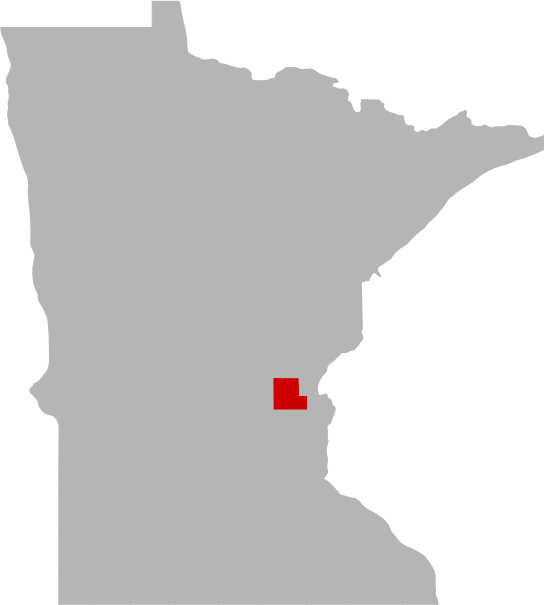
Isanti County, Minnesota

Share Your Catch & Win!
Frequently Asked Questions About Lake Fannie, MN
- How big is Lake Fannie?
- How deep is Lake Fannie?
- What kind of fish can you catch in Lake Fannie?
- Are there fishing guides or charters for Lake Fannie?
- What are the closest cities to Lake Fannie?
- Are there places to stay in the Lake Fannie area?
- Are there topographical lake maps available Lake Fannie?
- Are there boat launches on Lake Fannie?
- Are there places to eat and drink near Lake Fannie?
- What is the average air temp for Lake Fannie?
- Are there any state parks near Lake Fannie?
How big is Lake Fannie?
How deep is Lake Fannie?
What kind of fish can you catch in Lake Fannie?
Other fish species in the lake include Blackchin Shiner, Emerald Shiner, Fathead Minnow, Golden Redhorse, Golden Shiner, Green Sunfish, Hybrid Sunfish, Johnny Darter, Tadpole Madtom and White Sucker.
Are there fishing guides or charters for Lake Fannie?

What are the closest cities to Lake Fannie?
Are there places to stay in the Lake Fannie area?
More Lodging Options
Are there topographical lake maps available Lake Fannie?
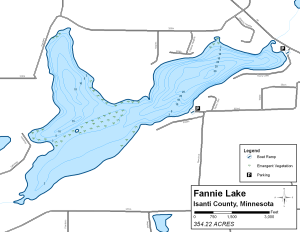
Are there boat launches on Lake Fannie?
Are there places to eat and drink near Lake Fannie?
Explore the Lake Fannie area in a RV
Are you looking for an adventurous vacation option that won't break the bank? Look no further than renting an RV! Contrary to popular belief, the process is much simpler than you might imagine. With just a few easy steps, you'll soon be experiencing the ultimate freedom and convenience of exploring the open road in your very own recreational vehicle. And the best part? RV travel can save you up to 60% compared to other types of vacations! With the money you'll save, you'll be able to travel even more and create unforgettable memories along the way. So why wait? Start planning your next adventure today with an RV rental. Learn more about renting a RV.


?Poppy? 2009 Forest River Rockwood Premier with heat and AC!
Brooklyn park, MN
What aquatic invasive species are found in Lake Fannie?
Join us in the fight to prevent the spread of invasive species These sneaky creatures can hitch a ride on boats, clinging onto propellers, anchor lines, and trailers. They can even survive in hidden places like bilge water and ballast tanks, or disguise themselves in dirt and sand that sticks to nets, buckets, anchors, and waders. But don't worry, we have the power to stop them in their tracks with just a few simple steps. So let's do our part and protect our waters from these unwanted invaders.
History & Status of the Fishery
Fannie Lake is a 366-acre lake located in Isanti County that has been assigned to lake class 34. The lake is managed primarily for Northern Pike, Largemouth Bass, Black Crappie, and Bluegill. To assess the current population, a population assessment was conducted from June 27 to 30, 2022 with standard lake survey gillnets and trap nets. Electrofishing was done on June 1 to sample the Largemouth Bass population.
The Walleye gillnet catch in 2022 was 15 fish, resulting in a catch rate of 2.5 per lift. This is the highest catch rate recorded for Walleye on this lake dating back to the 1996 survey. However, this is still a low number of Walleye and because Walleye numbers have been consistently low, Walleye fingerling stocking was discontinued after 2013. The management plan does call for Walleye fry to be stocked when surplus is available. Walleye fry were stocked in 2017, 2019, 2021, and 2022. The Walleye caught in the 2022 survey were large, with an average length of 23.7 inches, and ranged in size from 20.9 to 28.0 inches. This was also the largest average size of Walleye dating back to 1996 and the ages ranged from 10 to 14. All year classes corresponded to years when Walleye were stocked (either fry or fingerling), except age 13. As in past surveys, the Walleye population appears to be made up of mostly larger, older individuals at a low density.
The Northern Pike gillnet catch was 5.0 per lift as compared to 13.5 per lift in 2013, so the population appears to be at a more normal level at the present time and meets the management goal of 5.0 per lift. When comparing the catch to the combined average 1996, 2001, and 2006 (6.5 per net) which seem to represent more typical catch rates it is still slightly low. Northern Pike sampled in gillnets ranged from 22.1 to 35.2 inches with an average length of 27.0 inches in 2022. The average gillnet catch length has been steadily increasing since 1996. Northern Pike ranged in age from 3 to 9 years old. Overall, the Northern Pike population seems to be maintaining itself near the management goal and the fish have been steadily increasing in average size over the past five surveys.
Yellow Perch, primarily forage for both Northern Pike and Walleye, have historically fluctuated in abundance, but have never had a large presence in Fannie Lake. In 2022 the gillnet catch was 110 fish with a catch rate of 18.3 fish per net. This was the highest gillnet catch by number and rate dating back to the 1996 survey. Most of the fish in 2022 were between 6.0 and 6.5 inches with an average length of 6.4 inches ranging in size from 5.6 to 7.8 inches. The increasing number of perch should provide a good forage base for the Northern Pike and remaining Walleye in the lake but are likely too small to be targeted by anglers.
The Black Crappie gillnet catch in 2022 was 31, the highest in the five surveys from 1996 to 2022. Black Crappie caught in gillnets ranged in size from 5.2 to 9.3 inches, with a mean length of 6.8 inches. The average size caught in the gillnets was equal to that of 2013 and tied for the largest in the last five surveys. The 2022 Black Crappie trap net catch was 11. Black Crappie trap net catch ranged in size from 6.6 to 8.9 inches, with a mean length of 7.7 inches. The average size caught in the trap nets was less than in 2013 but was the second largest in the last five surveys. With the gillnet catch at the all-time high and the trap net catch about average, it looks like the numbers of Black Crappie has remained consistent, although the fish are of a relatively small average size.
The total Bluegill trap net catch was 297 for a catch rate of 37.0 per net. The 2022 catch was slightly below average as the average catch rate for surveys from 1996 to 2013 is 47.5 per net and the total catch average is 374 for those surveys. Bluegill sampled in trap nets in 2022 ranged in size from 3.0 to 7.9 inches with an average length of 5.9 inches. Most of the Bluegill were from 6.5 to 7.5 inches in length. In addition to the fish caught in trap nets in 2022, 258 Bluegill were captured in the gillnets. The average size of these fish was 6.6 inches with a length range of 4.1 to 7.9 inches. Based on the number of Bluegill caught in both the gillnets and trapnets it appears that the Bluegill population is doing quite well with regard to numbers, but the size structure is relatively small. This has been a consistent theme with Fannie Lake, as the average length for fish caught in both trap nets and gillnets has been around 6 inches and has not exceeded 6.6 inches in any survey from 1996 to 2022. Additionally, the maximum length of fish caught appears to be going down. In 1996 and 2001 there were fish exceeding 8.0 inches captured. No Bluegill exceeding 8 inches have been sampled since that time.
The Largemouth Bass catch rate of 70.3 per hour and total catch of 40 in 2022 was much higher than previous surveys in 1996, 2001, and 2006. Average length in 2022 was 11.8 inches with a length range of 4.7 to 19.5 inches. With the highest recorded catch both in number and rate, the Largemouth Bass population looks to be higher than it has ever been. The average size in 2022 is slightly down, but the maximum length in 2022 was the largest of the last four surveys. Overall, the number of Largemouth Bass appears to be increasing in the lake, but the average size is slightly declining.
Overall, the fishing on Fannie Lake for many species should be quite good. There are good numbers of Yellow Perch, Black Crappie, Bluegill, Largemouth Bass, and Northern Pike based on sampling with gillnets, trap nets, and electrofishing. The Walleye population appears to be the highest it has ever been, although the number of fish is still low, but they are of a nice average size. Northern Pike are increasing in size and 68% of the fish sampled were 26 inches and larger. Bluegill are abundant but on average run relatively small. The Largemouth Bass population appears to be very high currently, although the fish are on average smaller than in previous assessments.
What is the average air temp for Lake Fannie?
Are there any state parks near Lake Fannie?
For more Minnesota State Park information see our State Park Guide.
More Nearby Lakes To Explore
There's more lake's to explore around Lake Fannie...| DISTANCE | ACRES | MAX DEPTH | |
| Unnamed (NE Portion) Lake | 1.4 mi | 20 | |
| Unnamed (SW Portion) Lake | 1.5 mi | 22 | |
| Elms Lake | 1.6 mi | 52 | 26 ft |
| Skogman Lake | 2.0 mi | 228 | 36 ft |
| Florence Lake | 2.2 mi | 135 | 26 ft |
| Rum Lake | 3.1 mi | 25 | |
| Brobergs Lake | 3.7 mi | 20 | |
| Jonason Lake | 3.9 mi | 15 | |
| Splittstoeser Lake | 4.5 mi | 25 | |
| Olson Impoundment | 5.5 mi | 20 |


