


Upper Gull Lake
Cass County, Minnesota

Today's Fishing Forecast
Fishing looks to be fairly active with peak fishing times around 3-5 PM. SEE MORE
Share your catch!
We want to see what you've caught on Upper Gull Lake.Frequently Asked Questions About Upper Gull Lake, MN
- How big is Upper Gull Lake?
- How deep is Upper Gull Lake?
- What kind of fish can you catch in Upper Gull Lake?
- Are there fishing guides or charters for Upper Gull Lake?
- What are the closest cities to Upper Gull Lake?
- Are there places to stay in the Upper Gull Lake area?
- Are there topographical lake maps available Upper Gull Lake?
- Are there places to eat and drink near Upper Gull Lake?
- What are the fishing regulations for Upper Gull Lake?
- What is the average air temp for Upper Gull Lake?
- Are there any state parks near Upper Gull Lake?
How big is Upper Gull Lake?
How deep is Upper Gull Lake?
What kind of fish can you catch in Upper Gull Lake?
Other fish species in the lake include Banded Killifish, Blackchin Shiner, Bluntnose Minnow, Cisco (Tullibee), Fathead Minnow, Golden Shiner, Green Sunfish, Hybrid Sunfish, Johnny Darter, Ninespine Stickleback, Spottail Shiner and White Sucker.
Are there fishing guides or charters for Upper Gull Lake?


What are the closest cities to Upper Gull Lake?
Are there places to stay in the Upper Gull Lake area?
More Lodging Options
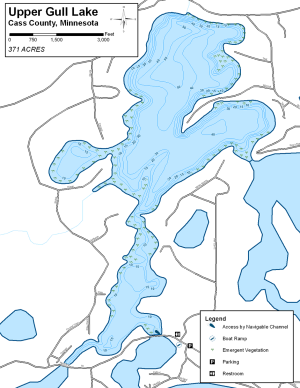
Are there topographical lake maps available Upper Gull Lake?
Are there places to eat and drink near Upper Gull Lake?
What are the fishing regulations for Upper Gull Lake?
 There are specific fishing regulations Upper Gull Lake that you need to know. For complete fishing regulations visit the Minnesota Department of Natural Resources. To report a violation call (800) 652-9093. Need a Minnesota fishing license?
What aquatic invasive species are found in Upper Gull Lake?
Join us in the fight to prevent the spread of invasive species These sneaky creatures can hitch a ride on boats, clinging onto propellers, anchor lines, and trailers. They can even survive in hidden places like bilge water and ballast tanks, or disguise themselves in dirt and sand that sticks to nets, buckets, anchors, and waders. But don't worry, we have the power to stop them in their tracks with just a few simple steps. So let's do our part and protect our waters from these unwanted invaders.
History & Status of the Fishery
A targeted survey of nearshore fish species in Upper Gull Lake was conducted beginning on July 6th, 2021 by Index of Biological Integrity (IBI) Program Staff. Sampling sites were evenly spaced around the lake and each was sampled by backpack electrofishing and seining with a 50-foot or 15-foot seine, where possible. Backpack electrofishing was completed at 10 sampling stations. Similarly, a 50-foot seine was used to sample seven stations and a 15-foot seine was used at three stations. Nearshore sampling captured 22 species of fish including seven species that are intolerant of disturbance (i.e. Banded Killifish, Blackchin Shiner, Blacknose Shiner, Iowa Darter, Least Darter, Mimic Shiner, and Rock Bass) and two that are tolerant of disturbance (i.e. Black Bullhead and Green Sunfish).
A concurrent summer trap net survey was conducted the week of July 6th, 2021 by IBI Program Staff. Nine trap nets were set along the shoreline and in shallow offshore locations that encompassed multiple habitat types. Bluegill and Pumpkinseed comprised a majority of the trap net catch by number, Bowfin and Yellow Bullhead comprised a majority of the trap net catch by biomass. Bowfin count per net and mean weight were both at or above the 75th quartile for similar Lake Class 25 lakes. The Bluegill count per net was below the 50th quartile, while their mean weight was below the 25th quartile for similar Lake Class 25 lakes.
The nearshore and trap net data were combined with gill net data from a June 2019 survey to describe the fish community and provide a Fish-based IBI (FIBI) score. The FIBI uses fish community data to measure a lake's health, and the types of fish species present can help identify any stressors that may be negatively affecting the lake environment. In Minnesota lakes, certain fish species cannot survive without clean water and a healthy habitat (e.g. Banded Killifish, Least Darter, and Rock Bass), while other species are tolerant of degraded conditions (e.g. Green Sunfish, Fathead Minnows, and Common Carp). The FIBI score, composed of several fish community diversity and composition metrics, indicates the overall health of a lake by comparing it to what is expected for a healthy lake. For additional information on the FIBI, search for "lake index of biological integrity" on the mndnr.gov website.
Data from this survey will contribute biological information about the health of the fish community to the Crow Wing River Watershed assessment process in coordination with MN Pollution Control Agency.
What is the average air temp for Upper Gull Lake?
Are there any state parks near Upper Gull Lake?
Pillsbury State Forest
Crow Wing State Forest
Cuyuna Country State Recreation Area
Crow Wing State Park
More Nearby Lakes To Explore
There's more lake's to explore around Upper Gull Lake...| DISTANCE | ACRES | MAX DEPTH | |
| Ray Lake | 0.7 mi | 143 | 27 ft |
| Spider Lake | 0.7 mi | 1,577 | |
| Roy Lake | 1.2 mi | 320 | 26 ft |
| Fawn Lake | 1.4 mi | 64 | 40 ft |
| Lake Edna | 1.6 mi | 156 | 63 ft |
| Margaret Lake | 2.2 mi | 248 | 26 ft |
| Margaret Lake | 2.2 mi | 248 | 26 ft |
| Margaret Lake (Kilpatrick) | 2.2 mi | 248 | 26 ft |
| Nisswa Lake | 2.3 mi | 219 | 23 ft |
| West Twin Lake | 2.3 mi | 127 | 42 ft |


