


Rice Lake
Stearns County, Minnesota


Share Your Catch & Win!
Frequently Asked Questions About Rice Lake, MN
- How big is Rice Lake?
- How deep is Rice Lake?
- What kind of fish can you catch in Rice Lake?
- What are the closest cities to Rice Lake?
- Are there places to stay in the Rice Lake area?
- Are there topographical lake maps available Rice Lake?
- Are there boat launches on Rice Lake?
- Are there places to eat and drink near Rice Lake?
- What is the average air temp for Rice Lake?
- Are there any state parks near Rice Lake?
How big is Rice Lake?
How deep is Rice Lake?
What kind of fish can you catch in Rice Lake?
Other fish species in the lake include Banded Killifish, Blackchin Shiner, Blacknose Shiner, Blackside Darter, Bluntnose Minnow, Brook Silverside, Central Mudminnow, Cisco (Tullibee), Common Shiner, Creek Chub, Fathead Minnow, Golden Shiner, Green Sunfish, Hornyhead Chub, Hybrid Sunfish, Iowa Darter, Johnny Darter, Logperch, Red Shiner, Shorthead Redhorse, Smallmouth Buffalo, Spotfin Shiner, Spottail Shiner, Tadpole Madtom and White Sucker.
What are the closest cities to Rice Lake?
Are there places to stay in the Rice Lake area?
More Lodging Options
Are there topographical lake maps available Rice Lake?
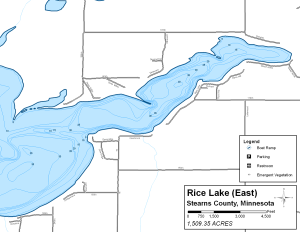
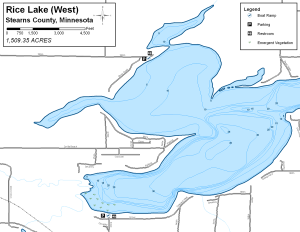
Are there boat launches on Rice Lake?
Are there places to eat and drink near Rice Lake?
Explore the Rice Lake area in a RV
Are you looking for an adventurous vacation option that won't break the bank? Look no further than renting an RV! Contrary to popular belief, the process is much simpler than you might imagine. With just a few easy steps, you'll soon be experiencing the ultimate freedom and convenience of exploring the open road in your very own recreational vehicle. And the best part? RV travel can save you up to 60% compared to other types of vacations! With the money you'll save, you'll be able to travel even more and create unforgettable memories along the way. So why wait? Start planning your next adventure today with an RV rental. Learn more about renting a RV.

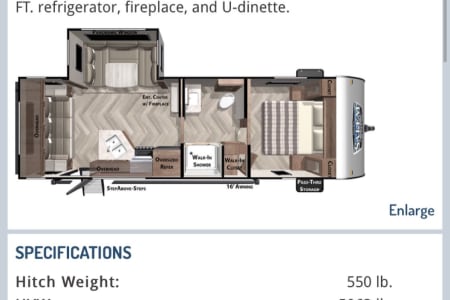
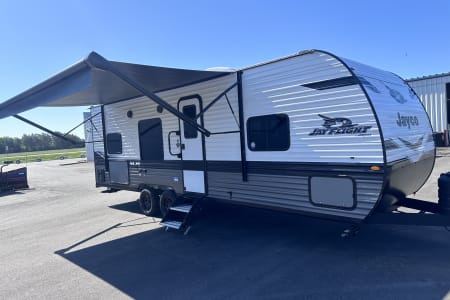

Spacious Family Camper: 5+ People, Fully Furnished, 1/2T towable
New London, MN
What aquatic invasive species are found in Rice Lake?
Join us in the fight to prevent the spread of invasive species These sneaky creatures can hitch a ride on boats, clinging onto propellers, anchor lines, and trailers. They can even survive in hidden places like bilge water and ballast tanks, or disguise themselves in dirt and sand that sticks to nets, buckets, anchors, and waders. But don't worry, we have the power to stop them in their tracks with just a few simple steps. So let's do our part and protect our waters from these unwanted invaders.
History & Status of the Fishery
A targeted fall night electrofishing survey was conducted for young of year "YOY" (fingerling sized) Walleye on Rice Lake during October 2, 2023. The 2023 fall night electrofishing survey was conducted at four stations for a total of 40 minutes. The water temperature was 71 F. Submergent vegetation densities were moderately abundant. We observed abundant numbers of Yellow Perch, Largemouth Bass, Sunfish species and Shiner/Darter species. We also saw moderate numbers of Black Crappie, White Sucker and Northern Pike in the 2023 fall electrofishing survey. A targeted survey is generally used for sampling a specific kind of fish or time of year (i.e. spawning season, fall season, etc.) unlike a standard survey which samples a wider range of fish species during the summer months using standard methodology (i.e. standard time of year, set sampling stations, taking water clarity readings and oxygen/temperature profiles, etc.) and gears (i.e. lake survey gillnets, trapnets and possibly spring electrofishing for Largemouth Bass).
Rice is a large (1,513 acres), moderately deep (41 feet), and productive lake located in Stearns County. Rice is a popular lake for angling (Walleye, bass, Bluegill, Black Crappie) and spearing (Northern Pike). Water levels were below normal in 2023. Aquatic vegetation densities are variable in the lake on a yearly basis. An invasive algal species, Starry Stonewort, was found in low densities near the southwest public access during 2016. However, it has currently spread throughout Rice Lake. Presently, Starry Stonewort has spread throughout the Mud Lake Basin and Lake Koronis since it was found in 2015. Zebra Mussels were found in Koronis during 2022. Shoalwater substrates are diverse with boulder and rubble areas near points with soft sediments like silt, marl, detritus and sand found in the near shore and bay areas of Rice Lake.
Rice Lake is upstream and connects to Lake Koronis via the North Fork of the Crow River. In the past, Walleye from both Rice and Koronis have spawned in the North Fork of the Crow River upstream of Rice Lake. A Walleye egg take station was operated just upstream of Rice Lake in the Crow River from the 1970's to 1992. However, this Walleye spawning run now appears to be considerably reduced. This is based on anecdotal observations of lower opening Walleye fishing activity near the downstream Koronis inlet bay/narrows area especially since the 2000's and recent (2018-2019) ice out hoop netting in the river near the old egg take station. Walleye also spawn adjacent to the east shores of the three islands in Koronis and the east point of Rice. Since 2001, both Koronis and Rice have been periodic "Spicer Strain" Walleye egg take sites for the statewide Walleye propagation program. Other recent Spicer Strain egg take lakes include Diamond and Elizabeth. Historic spawning sites for Walleye in both Koronis and Rice have been degraded in recent years with increased sedimentation, algal and periphyton growth.
Walleye natural reproduction in Rice was generally both frequent and adequate to sustain Walleye numbers based on previous fall and summer surveys, and markings. Various combinations of Walleye fingerlings, yearlings and adults were stocked in Rice after years of consecutive poor natural reproduction or fry stocking success during 2007 (25,310 fish, 2,556 pounds), 2008 (417 fish, 330 pounds), 2010 (15,281 fish, 1,923 pounds), 2018 (7,164 yearlings, 2,044 pounds; 125 adults, 167 pounds; 100 fingerlings, 6 pounds), 2019 (18,815 fingerlings, 1,533 pounds), 2021 (4,571 fingerlings, 976 pounds) and 2022 (63,962 fingerlings, 2,152 pounds). Walleye fry (500K to 2 million each year) were stocked during 2001 2019 as a 10% return of Walleye eggs taken for the DNR statewide Walleye hatching program. No Walleye eggs were taken and no fry were stocked in 2020. No Walleye eggs were taken, but fry were stocked during 2021 (573,169 fry) in Rice. Walleye fry were also stocked in 2022 (959,635 fry) and 2023 (1,201,133 fry). Walleye eggs were taken in 2022 (77.75 quarts) and 2023 (154.25 quarts). Stocked Walleye fry were marked with Oxytetracycline "OTC" in 2001, 2007, 2009 and 2011-16 in Rice.
Low YOY Walleye numbers (1.50/hour, 7.05 inches) were caught in the 2023 fall night electrofishing survey. Abundant numbers of yearling Walleye (42.00/hour, 8.91 inches) were caught in the 2023 fall night electrofishing survey. The yearling Walleye captured in 2023 were likely from a 2022 fingerlings stocking. Low YOY Walleye numbers (4.50/hour, 7.38 inches) were caught in the 2022 fall night electrofishing survey. No YOY Walleye were captured during the 2021 fall night electrofishing survey. Low YOY Walleye numbers (0.50 YOY/hour) were observed in the 2020 fall night electrofishing survey. Moderate yearling numbers (15.00 fish/hour, 10.06 inches) were captured in the 2020 fall electrofishing survey. The yearling Walleye captured in 2020 were probably from a 2019 fingerling stocking. No YOY Walleye were captured in the 2019 or 2018 fall electrofishing surveys. Low YOY Walleye numbers were captured in 2017 (3.00 YOY/hour, 7.81 inches). Generally, low YOY Walleye numbers were captured in fall night electrofishing surveys from 2005-2010 and 2012. Moderate YOY Walleye year classes due to natural reproduction or fry stockings were documented in 2003 (42.00 YOY/hour, 6.46 inches), 2004 (55.50 YOY/hour, 6.74 inches), 2011 (150.00 YOY/hour, 6.27 inches), 2013 (37.33 YOY/hour, 6.31 inches), 2014 (82.00 YOY/hour, 5.98 inches), 2015 (36.00 YOY/hour, 6.03 inches) and 2016 (56.00 YOY/hour, 5.81 inches). Approximately 62% of the YOY Walleye captured in the 2011, 2013 and 2014 fall electrofishing surveys were OTC marked fish from fry stockings. OTC marked fish contributed 83% and 44% of the 2015 and 2016 year classes respectively in fall electrofishing surveys. Moderate yearling Walleye numbers were captured in 2017 (16.50 YOY/hour, 9.42 inches) and 2014 (18.00 fish/hour).
Walleye abundance in 2022 summer survey (7.60 fish/gillnet) was below the historical average catch rate of 9.56 fish/gillnet for Rice. The 2022 Walleye average weight and length were 2.53 pounds and 18.79 inches respectively from gillnets. The Walleye historical average length is 16.25 inches from gillnets. The 2022 catch rate of quality size (15.00 inches plus) Walleye was 6.60 fish/gillnet. Walleye growth rates were near or above the Spicer Area normal ranges. The 2019 year class comprised 30% of the 2022 summer gillnet and trapnet catch. Other year classes present included 2018 at 10%, 2017 at 18%, 2016 at 16%, 2015 at 6% and 2014 at 6% of the 2022 gillnet and trapnet catch. Only one Oxytetracycline "OTC" marked fish (fry stocked in 2014) was captured in the 2022 survey nets.
Current fish management activities on Rice include protecting important aquatic vegetation through the permit process, participating in local watershed projects, assisting aquatic plant management and enforcement personnel with invasive species monitoring and education, considering potential starry stonewort/curly leaf pondweed management options, operating the Northern Pike spawning area as needed, and stocking Walleye fry or fingerlings as required or needed. The Rice Lake fishery will be surveyed during the 2024 fall for YOY Walleye by electrofishing and 2024 summer by standard survey gears for all species.
What is the average air temp for Rice Lake?
Are there any state parks near Rice Lake?
For more Minnesota State Park information see our State Park Guide.
More Nearby Lakes To Explore
There's more lake's to explore around Rice Lake...| DISTANCE | ACRES | MAX DEPTH | |
| Unnamed Lake | 1.4 mi | 10 | |
| Pirz Lake | 1.8 mi | 67 | |
| Deep Lake | 3.3 mi | 54 | 54 ft |
| Mud Lake | 3.4 mi | 156 | |
| Big Lake | 3.9 mi | 458 | 42 ft |
| North Brown's Lake | 3.9 mi | 312 | 41 ft |
| Mud Lake | 4.2 mi | 67 | |
| South Brown's Lake | 4.3 mi | 65 | 5 ft |
| Long Lake | 4.5 mi | 487 | 35 ft |
| Eden Lake | 4.6 mi | 278 | 77 ft |


