


Great Northern Lake
Stearns County, Minnesota


Share Your Catch & Win!
Frequently Asked Questions About Great Northern Lake, MN
- How big is Great Northern Lake?
- How deep is Great Northern Lake?
- What kind of fish can you catch in Great Northern Lake?
- What are the closest cities to Great Northern Lake?
- Are there places to stay in the Great Northern Lake area?
- Are there places to eat and drink near Great Northern Lake?
- What are the fishing regulations for Great Northern Lake?
- What is the average air temp for Great Northern Lake?
How big is Great Northern Lake?
How deep is Great Northern Lake?
What kind of fish can you catch in Great Northern Lake?
Other fish species in the lake include Bluntnose Minnow, Brook Silverside, Golden Shiner, Hybrid Sunfish, Johnny Darter, Logperch, Shorthead Redhorse, Silver Redhorse, Spotfin Shiner and White Sucker.
What are the closest cities to Great Northern Lake?
Are there places to stay in the Great Northern Lake area?
More Lodging Options
Are there places to eat and drink near Great Northern Lake?
What are the fishing regulations for Great Northern Lake?
 There are specific fishing regulations Great Northern Lake that you need to know. For complete fishing regulations visit the Minnesota Department of Natural Resources. To report a violation call (800) 652-9093. Need a Minnesota fishing license?
Explore the Great Northern Lake area in a RV
Are you looking for an adventurous vacation option that won't break the bank? Look no further than renting an RV! Contrary to popular belief, the process is much simpler than you might imagine. With just a few easy steps, you'll soon be experiencing the ultimate freedom and convenience of exploring the open road in your very own recreational vehicle. And the best part? RV travel can save you up to 60% compared to other types of vacations! With the money you'll save, you'll be able to travel even more and create unforgettable memories along the way. So why wait? Start planning your next adventure today with an RV rental. Learn more about renting a RV.

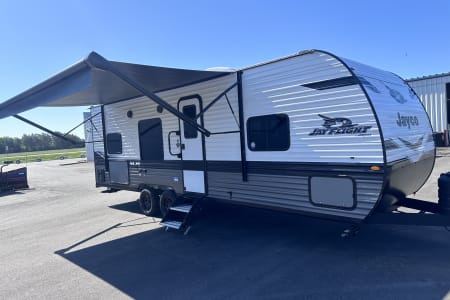
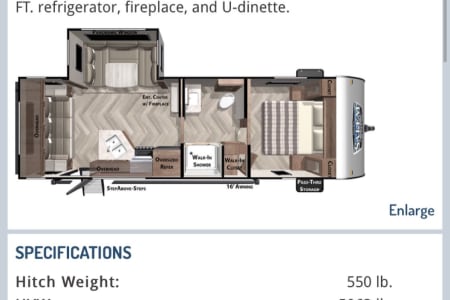
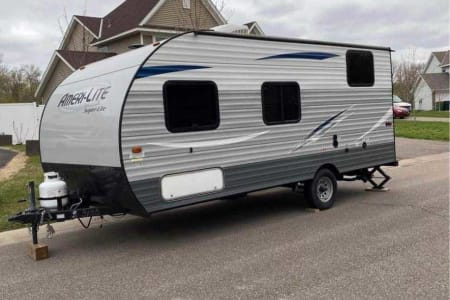
Extremely light, very easy to tow 2019 Gulf Stream Amerilite
Cold spring, MN
What aquatic invasive species are found in Great Northern Lake?
Join us in the fight to prevent the spread of invasive species These sneaky creatures can hitch a ride on boats, clinging onto propellers, anchor lines, and trailers. They can even survive in hidden places like bilge water and ballast tanks, or disguise themselves in dirt and sand that sticks to nets, buckets, anchors, and waders. But don't worry, we have the power to stop them in their tracks with just a few simple steps. So let's do our part and protect our waters from these unwanted invaders.
History & Status of the Fishery
The Sauk River Chain of Lakes (SRCL) is located in Stearns County near the City of Richmond. The chain is comprised of numerous, connected waterbodies totaling over 3,200 acres. Horseshoe and Cedar Island Lakes are the largest basins in the chain and total over 1,500 acres. Prior to 2001, the Walleye fishery had been sustained through fingerling stocking. Since then, the Walleye population has been sustained through natural reproduction and fry stocking during odd numbered years. Annual fall electrofishing for young of year (YOY) Walleye was initiated in 2015 and documented adequate natural reproduction to sustain the fishery in the SRCL. Due to the strong natural reproduction, no Walleye stocking has occurred since 2017.
Night electrofishing was conducted on October 9, 2023, to evaluate natural reproduction in the East Lakes (Bolfing, Great Northern, Knaus, Krays, Schneider and Zumwalde lakes). Portions of Great Northern, Schneider, Krays, and Knaus Lakes were sampled, yielding a young of the year (YOY) catch rate of 6.4/hour, the lowest on record. From 2018 - 2023 YOY catch rates in the East lakes have averaged 75.7/hr compared to 53/hr in 2015 and 38/hr in 2017 years when stocking occurred. YOY lengths ranged from 5.4 to 7.6 inches with an average length of 6.9 inches.
For age-1 and older Walleye, the catch rate was 35.4/hr with those fish ranging in length from 7.9 to 26.3 inches. This is less than the average of non-stocked years (56.4/hour) and stocked years (63.4/hour) and much less than 2021 and 2020 when the catch of age-1 and older Walleye was 90.2/hour and 94.4/hour, respectively.
In 2021, targeted gill net surveys were conducted throughout the chain to provide a current assessment of Walleye recruitment to the fishery. The Walleye catch in the East Lakes was 4.2/gill net which was the third highest on record, whereas the Walleye catch across the chain (5.3/gill net) was the highest on record. Ageing data indicated that 89% of the total catch were from naturally produced years indicating that natural reproduction is sustaining the population.
What is the average air temp for Great Northern Lake?
More Nearby Lakes To Explore
There's more lake's to explore around Great Northern Lake...| DISTANCE | ACRES | MAX DEPTH | |
| Krays Lake | 0.5 mi | 95 | 40 ft |
| Schneider Lake | 0.6 mi | 60 | 52 ft |
| Bolfing Lake | 0.7 mi | 109 | 36 ft |
| Zumwalde Lake | 0.9 mi | 128 | 23 ft |
| Knaus Lake | 0.9 mi | 216 | 20 ft |
| Cedar Island Lake | 1.7 mi | 986 | 75 ft |
| Thein Lake | 2.0 mi | 35 | |
| Shackman Lake | 3.0 mi | 57 | |
| Unnamed Lake | 3.1 mi | 12 | |
| Horseshoe Lake | 3.3 mi | 629 | 57 ft |


