


Sturgeon Lake
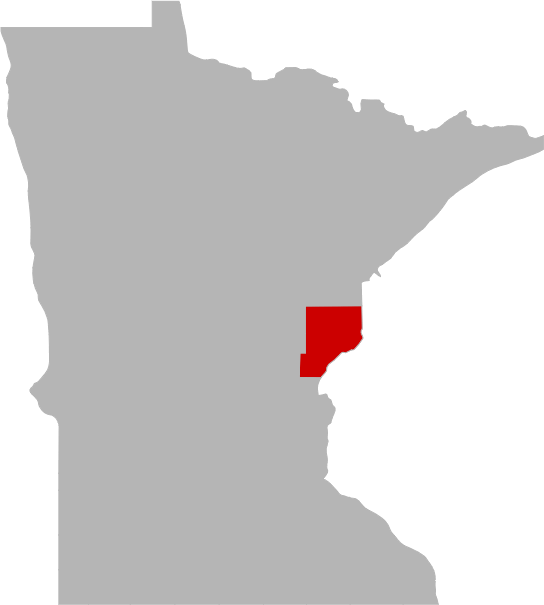
Pine County, Minnesota

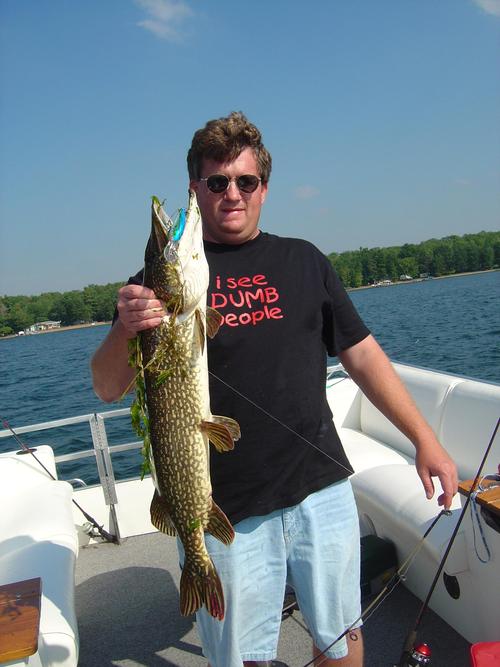
Share Your Catch & Win!
Frequently Asked Questions About Sturgeon Lake, MN
- How big is Sturgeon Lake?
- How deep is Sturgeon Lake?
- What kind of fish can you catch in Sturgeon Lake?
- What are the closest cities to Sturgeon Lake?
- Are there places to stay in the Sturgeon Lake area?
- Are there topographical lake maps available Sturgeon Lake?
- Are there boat launches on Sturgeon Lake?
- Are there places to eat and drink near Sturgeon Lake?
- What is the average air temp for Sturgeon Lake?
- Are there any state parks near Sturgeon Lake?
How big is Sturgeon Lake?
How deep is Sturgeon Lake?
What kind of fish can you catch in Sturgeon Lake?
Other fish species in the lake include Banded Killifish, Blacknose Shiner, Bluntnose Minnow, Central Mudminnow, Fathead Minnow, Golden Shiner, Green Sunfish, Hybrid Sunfish, Iowa Darter, Johnny Darter, Spotfin Shiner, Spottail Shiner, Tadpole Madtom and White Sucker.
What are the closest cities to Sturgeon Lake?
Are there places to stay in the Sturgeon Lake area?
More Lodging Options
Are there topographical lake maps available Sturgeon Lake?
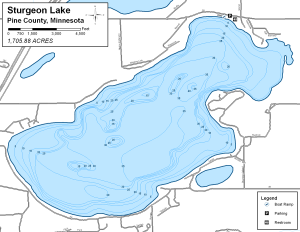
Are there boat launches on Sturgeon Lake?
Are there places to eat and drink near Sturgeon Lake?
Explore the Sturgeon Lake area in a RV
Are you looking for an adventurous vacation option that won't break the bank? Look no further than renting an RV! Contrary to popular belief, the process is much simpler than you might imagine. With just a few easy steps, you'll soon be experiencing the ultimate freedom and convenience of exploring the open road in your very own recreational vehicle. And the best part? RV travel can save you up to 60% compared to other types of vacations! With the money you'll save, you'll be able to travel even more and create unforgettable memories along the way. So why wait? Start planning your next adventure today with an RV rental. Learn more about renting a RV.
What aquatic invasive species are found in Sturgeon Lake?
Join us in the fight to prevent the spread of invasive species These sneaky creatures can hitch a ride on boats, clinging onto propellers, anchor lines, and trailers. They can even survive in hidden places like bilge water and ballast tanks, or disguise themselves in dirt and sand that sticks to nets, buckets, anchors, and waders. But don't worry, we have the power to stop them in their tracks with just a few simple steps. So let's do our part and protect our waters from these unwanted invaders.
History & Status of the Fishery
Sturgeon Lake is a 1,405-acre lake in northern Pine County with an average depth of 22 feet and a maximum depth of 40 feet. Water clarity is good with visibility to around 10 feet. There is a public water access on the north end, two resorts, and a YMCA camp. A high amount of shoreline development is present, with most of the shoreline having cabins or homes. In 2023 a lake survey was conducted from July 31 to August 4 using nine gill nets and 12 trap nets to evaluate the fish population.
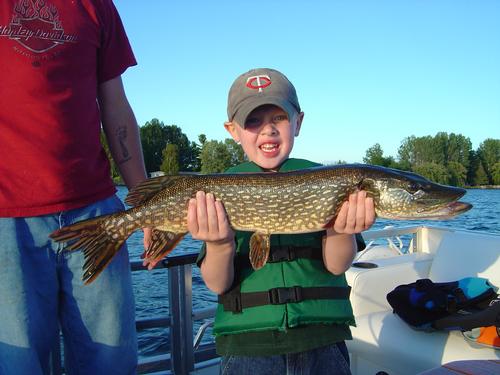
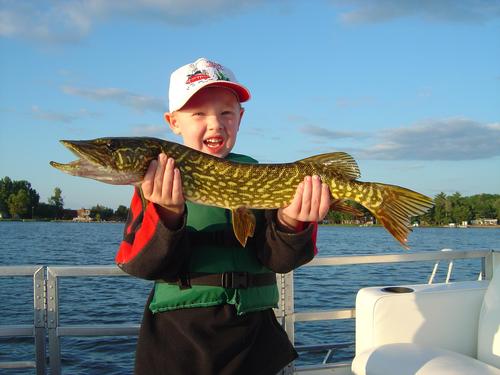
Since the 1990s, the primary fisheries concern has been the high number of small Northern Pike. In 2023 most pike caught were under 22 inches (96%). Only one fish sampled was over 26 inches. A 20 inch maximum regulation for pike was implemented in 1997. This regulation was modified to a 24-to-36 inch protected slot in 2008, which was in place through 2018. In 2019 the statewide North Central zone regulation was adopted (10 bag limit, fish between 22 and 26 inches must be released, 2 over 26 inches may be kept). The goal of these regulations has been to reduce the number of small pike and to improve pike size structure. These goals have not been achieved. Likely causes of high pike numbers include high amounts of natural reproduction and recruitment, as well as extensive spawning and nursery habitat.
The Walleye catch rate of 1.2 per gillnet was below the management plan goal of 5.0 per net. It was the lowest catch rate and number sampled since 1982. Walleye gillnet catch rates have varied from 1.2 per net in 2023 to 7.8 per net in 1986, with an average gillnet catch rate of 3.3 (1982 to 2023). Eleven Walleyes were sampled during the 2023 survey in gill nets. Walleyes ranged from 11.4 to 20.7 inches and had an 18.6-inch average. Walleye catch rates have declined over the past several surveys. Ages estimated from otoliths indicated three year classes were sampled (2016, 2019, 2021). These year classes corresponded to stocked years. Current Walleye stocking plans call for stocking 495 pounds of fall fingerlings on even numbered years.
The Black Crappie gillnet catch was the highest recorded since 1982, both by catch rate (6.9 per net) and number (62). The average gillnet catch rate from 1982 to 2023 is 2.4 per net. Trap net catch was also high in 2023. It was the second highest recorded dating back to 1982, with only 2001 having a higher total catch and catch rate. Crappies sampled from gill and trap nets combined ranged from 4.9 to 12.5 inches and had a 7.9-inch average.
Bluegill numbers have increased since 2019 based on trap net catches. The catch rate of 18.8 per net exceeded that of 2019 (10.6). The trap net catch was also above the average catch of 188 and catch rate of 17.9 per net. Bluegills sampled in gill nets and trap nets combined ranged from 3.3 to 11.4 inches and had a 6.9-inch average. A total of 276 Bluegills were measured. Of sampled Bluegill, 72% were over 6.0 inches, 59% were over 7 inches, and 28% were over 8 inches. The Bluegill population has good size structure.
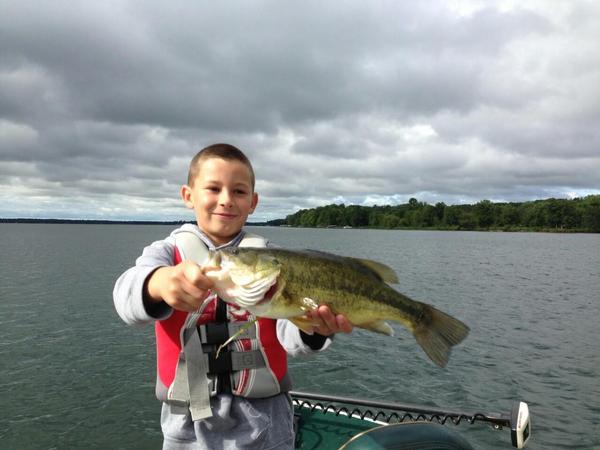
Largemouth Bass were not targeted with spring electrofishing in 2023. However, there were 81 captured with gill and trap nets combined. The majority (73) were caught with gill nets. The combined catch ranged in length from 5.2 to 16.0 inches. Most were from 9.0 to 10.9 inches, and from 14.0 to 14.9 inches. Even though electrofishing was not conducted in 2023, the dramatic increase in the gillnet catch indicates the bass population is currently high.
Yellow perch numbers remain low. In an attempt to increase the perch population, stocking yearling and adult perch occurred in 2007, 2008, and 2013. Based on the 2023 catch it appears these stocking attempts were unsuccessful. The high number of small pike will likely result in perch numbers remaining low.
Other fish sampled in the survey included Black Bullhead, Brown Bullhead, Green Sunfish, Hybrid Sunfish, Pumpkinseed, Rock Bass, and Yellow Bullhead. White Sucker was the only species sampled in 2019 that was not sampled in 2023.
Overall, the high number of small pike continues to be a concern. Small pike density likely influences perch and Walleye numbers. While regulations intended to decrease the density of small pike have occurred since 1997, they have been unsuccessful. The Largemouth Bass population continues to remain high based on the high number sampled in gill nets. Bluegill and crappie populations are doing well, both near all-time high catches.
If anglers want some fishing action for small pike, nice Largemouth Bass, and the opportunity to catch some nice Bluegill and crappie, Sturgeon Lake is a good choice.
What is the average air temp for Sturgeon Lake?
Are there any state parks near Sturgeon Lake?
For more Minnesota State Park information see our State Park Guide.
Sturgeon Lake Reviews
Below is the word on street about Sturgeon Lake.Have you been to Sturgeon Lake? Why not share your personal reveiw with others?
Submit Review
justin b.

More Nearby Lakes To Explore
There's more lake's to explore around Sturgeon Lake...| DISTANCE | ACRES | MAX DEPTH | |
| Unnamed Lake | 1.5 mi | 17 | |
| Close Lake | 1.6 mi | 33 | 37 ft |
| Rush Lake | 1.7 mi | 78 | 37 ft |
| Island Lake | 1.9 mi | 527 | 42 ft |
| Turtle Lake | 2.1 mi | 27 | |
| Lords Lake | 2.2 mi | 30 | |
| Big Slough | 2.3 mi | 62 | 14 ft |
| Passenger Lake | 2.3 mi | 67 | 22 ft |
| Dago Lake | 2.4 mi | 118 | 20 ft |
| Unnamed Lake | 2.4 mi | 36 | 20 ft |


