


Shamineau Lake
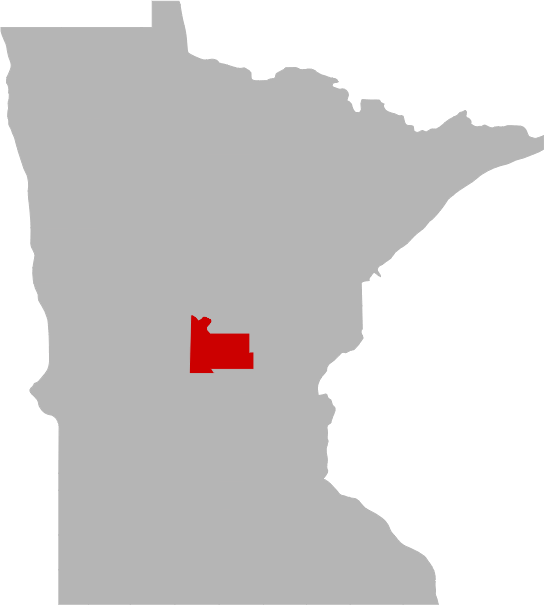
Morrison County, Minnesota
Share your catch!
We want to see what you've caught on Shamineau Lake.Frequently Asked Questions About Shamineau Lake, MN
- How big is Shamineau Lake?
- How deep is Shamineau Lake?
- What kind of fish can you catch in Shamineau Lake?
- What are the closest cities to Shamineau Lake?
- Are there places to stay in the Shamineau Lake area?
- Are there topographical lake maps available Shamineau Lake?
- Are there boat launches on Shamineau Lake?
- Are there places to eat and drink near Shamineau Lake?
- What are the fishing regulations for Shamineau Lake?
- What is the average air temp for Shamineau Lake?
- Are there any state parks near Shamineau Lake?
How big is Shamineau Lake?
How deep is Shamineau Lake?
What kind of fish can you catch in Shamineau Lake?
Other fish species in the lake include Banded Killifish, Blackchin Shiner, Blacknose Shiner, Bluntnose Minnow, Fathead Minnow, Golden Redhorse, Golden Shiner, Hybrid Sunfish, Iowa Darter, Johnny Darter, Least Darter, Spottail Shiner, Tadpole Madtom and White Sucker.
What are the closest cities to Shamineau Lake?
Are there places to stay in the Shamineau Lake area?
More Lodging Options
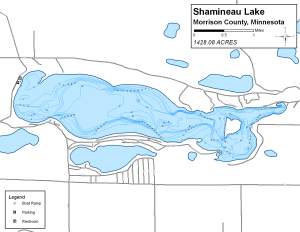
Are there topographical lake maps available Shamineau Lake?
Are there boat launches on Shamineau Lake?
Are there places to eat and drink near Shamineau Lake?
What are the fishing regulations for Shamineau Lake?
 There are specific fishing regulations Shamineau Lake that you need to know. For complete fishing regulations visit the Minnesota Department of Natural Resources. To report a violation call (800) 652-9093. Need a Minnesota fishing license?
Explore the Shamineau Lake area in a RV
Are you looking for an adventurous vacation option that won't break the bank? Look no further than renting an RV! Contrary to popular belief, the process is much simpler than you might imagine. With just a few easy steps, you'll soon be experiencing the ultimate freedom and convenience of exploring the open road in your very own recreational vehicle. And the best part? RV travel can save you up to 60% compared to other types of vacations! With the money you'll save, you'll be able to travel even more and create unforgettable memories along the way. So why wait? Start planning your next adventure today with an RV rental. Learn more about renting a RV.


What aquatic invasive species are found in Shamineau Lake?
Join us in the fight to prevent the spread of invasive species These sneaky creatures can hitch a ride on boats, clinging onto propellers, anchor lines, and trailers. They can even survive in hidden places like bilge water and ballast tanks, or disguise themselves in dirt and sand that sticks to nets, buckets, anchors, and waders. But don't worry, we have the power to stop them in their tracks with just a few simple steps. So let's do our part and protect our waters from these unwanted invaders.
History & Status of the Fishery
Shamineau Lake (DOW# 49-0127-00; Lake Class 27) is a 1,434 acre lake located near Motley, Minnesota. A Minnesota Department of Natural Resources (MNDNR) owned concrete boat ramp is located on the west shore and a township owned gravel boat ramp is located on the east shore. Shamineau Lake has 10.34 miles of shoreline and a maximum depth of 52 feet. The lake is primarily managed for Walleye and Northern Pike and secondarily for Largemouth Bass, Muskellunge, Black Crappie, and Bluegill. The lake was initially surveyed in 1957 and 44 fish sampling surveys or investigations have occurred since then with the most recent prior sampling in 2022 (Fall Targeted Sampling for young or the year Walleye).
Walleye have been stocked in Shamineau Lake since at least 1947. Fry, fingerlings, yearlings, and adults have been stocked in the past and the lake management plan called for fingerling stocking on an annual or biennial basis through 2016. Walleye fry have been stocked in fourteen years since 2000 to determine whether Walleye population goals could be met utilizing fry as a cheaper alternative to fingerling stocking. The current stocking plan calls for annual fry stocking with the potential for future fingerling stocking if fry stocking shows consistently poor results. Fry stocking is favored, as fingerlings have become increasingly difficult to raise due to lack of winterkill in Walleye production ponds. Some Walleye natural reproduction has been documented in non-stocked years, but it has been assumed to be inadequate to maintain the population within management goals. Including 2023, nine fall young of the year Walleye electrofishing assessments have been conducted in years when fry stocking has occurred. In addition, three fall young of the year Walleye electrofishing assessments were completed in 1996, 2011 and 2020 when no stocking occurred to evaluate natural reproduction. No stocking occurred in 2020 due to the shutdown of fisheries Walleye egg take and hatchery operations due to the Covid 19 pandemic.
Initially fall Walleye assessments utilized one hour of electrofishing on-time effort in three stations to document abundance. Beginning in 2020, sampling time increased to two hours and six stations, as Shamineau Lake was included as a control lake in a research project aimed at determining Zebra Mussel impacts on Walleye recruitment. Currently, Zebra Mussels have not been detected in Shamineau Lake.
This 2023 fall electrofishing assessment was conducted on September 27 to evaluate young of the year Walleye abundance from spring fry stocking. Due to low catches of young of the year Walleye, only 3 of 6 stations were sampled. A total of three young of the year Walleye were captured in one hour of on time during the 2023 survey for a catch rate of 3.0/hour. This catch rate was equal to the median (3.0/hour) established from previous fall electrofishing surveys on Shamineau Lake. Catch rates from previous fry stocking evaluations ranged from 2.0/hour (2004) to 69.7/hour (2022). Individuals captured in 2023 averaged 7.0 inches, which was larger than the mean from all previous assessments and ranged from 6.0 to 7.8 inches in total length. Catch rates from non-stocked years have typically been low ranging from 0.0/hour (1996) to 2.0/hour (2020). Fall electrofishing catches have been an inconsistent predictor of year class strength in future gill net surveys. Past catch rates of 18 or higher young of the year Walleye per hour have produced future gill net catches up to 1.9/net. However, some year classes with low fall juvenile Walleye catch rates have also been well represented in future gill net surveys. It is difficult to predict the 2023-year class's future contribution to future gill net or angler catches.
Further examination of the extent of natural reproduction is warranted in non-stocked or fingerling stocked years in the future. Natural reproduction observed in some assessments raises questions regarding the origin of YWAE captured in other recent assessments including fry stocked years.
Smallmouth Bass have been sampled in increasing frequency in recent assessments and are particularly common along the north shoreline. Most Smallmouth encountered were juvenile size although one 12-inch fish was observed. Bluegill, Hybrid Sunfish, Largemouth Bass, Rock Bass, Yellow Bullhead and Yellow Perch were observed frequently at most stations. Shiner species and White Suckers were also present. A few Northern Pike were encountered during sampling. Habitat conditions appeared to be good with barren substrates preferred by juvenile Walleye prevalent in all three stations sampled.
What is the average air temp for Shamineau Lake?
Are there any state parks near Shamineau Lake?
For more Minnesota State Park information see our State Park Guide.
Shamineau Lake Reviews
Below is the word on street about Shamineau Lake.Have you been to Shamineau Lake? Why not share your personal reveiw with others?
Submit Review
jeff c.

sandy v.
More Nearby Lakes To Explore
There's more lake's to explore around Shamineau Lake...| DISTANCE | ACRES | MAX DEPTH | |
| Crookneck Lake | 0.8 mi | 183 | 22 ft |
| Perch Lake | 1.0 mi | 86 | |
| Lena Lake | 1.6 mi | 84 | |
| Ham Lake | 2.3 mi | 42 | 22 ft |
| Cass County Lake | 2.4 mi | 25 | |
| Fish Lake | 3.0 mi | 30 | 49 ft |
| Fish Trap Lake | 3.1 mi | 1,164 | 42 ft |
| Stanchfield Lake | 3.2 mi | 116 | 32 ft |
| Round Lake | 3.2 mi | 99 | 18 ft |
| Round Lake (Bergstrom) | 3.2 mi | 99 | 18 ft |


