


Sabre Lake
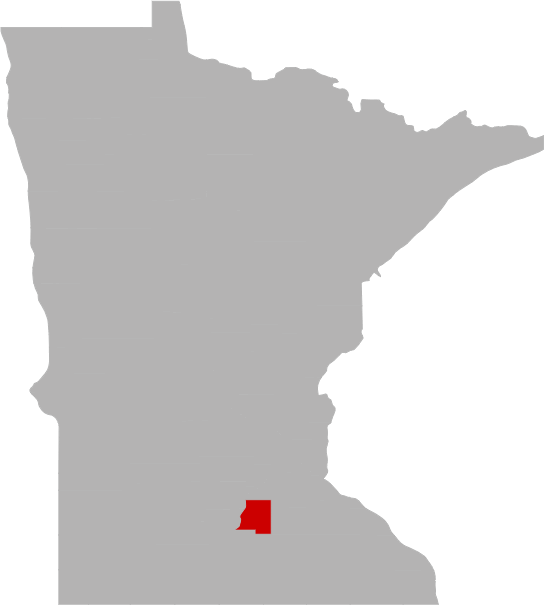
Le Sueur County, Minnesota

Today's Fishing Forecast
Fishing looks to be moderately active with peak fishing times around 8-9 AM and 3-5 PM. SEE MORE
Share your catch!
We want to see what you've caught on Sabre Lake.Frequently Asked Questions About Sabre Lake, MN
- How big is Sabre Lake?
- How deep is Sabre Lake?
- What kind of fish can you catch in Sabre Lake?
- What are the closest cities to Sabre Lake?
- Are there places to stay in the Sabre Lake area?
- Are there topographical lake maps available Sabre Lake?
- Are there boat launches on Sabre Lake?
- Are there places to eat and drink near Sabre Lake?
- What is the average air temp for Sabre Lake?
- Are there any state parks near Sabre Lake?
How big is Sabre Lake?
How deep is Sabre Lake?
What kind of fish can you catch in Sabre Lake?
Other fish species in the lake include Freshwater Drum, Green Sunfish, Highfin Carpsucker, Johnny Darter, Quillback, Spottail Shiner, Tadpole Madtom and White Sucker.
What are the closest cities to Sabre Lake?
Are there places to stay in the Sabre Lake area?
More Lodging Options
Are there topographical lake maps available Sabre Lake?
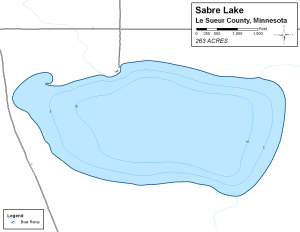
Are there boat launches on Sabre Lake?
Are there places to eat and drink near Sabre Lake?
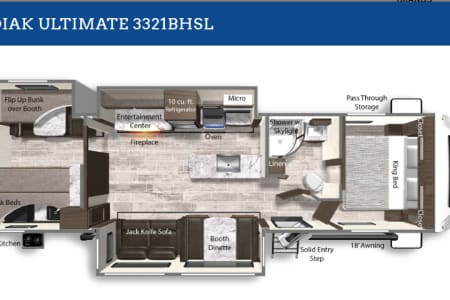
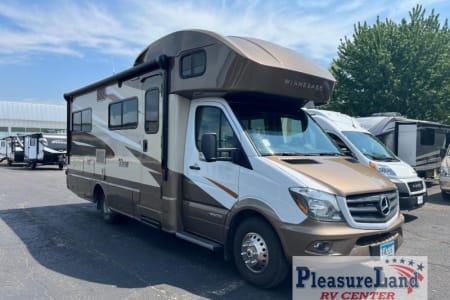
Explore the Sabre Lake area in a RV
Are you looking for an adventurous vacation option that won't break the bank? Look no further than renting an RV! Contrary to popular belief, the process is much simpler than you might imagine. With just a few easy steps, you'll soon be experiencing the ultimate freedom and convenience of exploring the open road in your very own recreational vehicle. And the best part? RV travel can save you up to 60% compared to other types of vacations! With the money you'll save, you'll be able to travel even more and create unforgettable memories along the way. So why wait? Start planning your next adventure today with an RV rental. Learn more about renting a RV.


History & Status of the Fishery
Sabre Lake is a 263-acre lake located in Le Sueur County west of the town of Kilkenny. A public access is located on the north side of the lake off Le Sueur County Road 2. Sabre Lake has a maximum depth of 13 feet. Sabre Lake is managed primarily for Walleye and is stocked with Walleye fry each year at a rate of 500 per littoral acre as part of a Walleye strain evaluation study. A contingency stocking plan calls for Northern Pike adults (200 pounds), Yellow Perch adults (100 pounds), Black Crappie adults (258 pounds), and Bluegill adults (258 pounds) to be stocked after winterkill events.
Sabre Lake was surveyed the week of 17 June 2021 as part of a regular monitoring program conducted by Minnesota DNR. This survey was intended to assess the fish community by deploying six gill nets and nine trap nets, as well as recording water quality parameters.
Walleye catch rates in Sabre Lake have remained relatively stable throughout the survey history, averaging 3.7 fish/gill net. The 2021 survey yielded 6.7 fish/gill net, which was a historic high for Walleye catch rate in Sabre Lake. Walleye were moderate sized, ranging from 10.4 to 25.6 inches and averaging 16.4 inches. Forty of the 47 Walleye aged were determined to be 2 or 3 years of age. These strong year classes were the result of stocking events in 2018 and 2019.
Twenty-two Yellow Perch were sampled in the 2021 survey at Sabre Lake. The gill net catch rate was 3.1 fish/net which was below the long-term average of 4.9 fish/net. Yellow Perch lengths ranged from 6.9 to 10.8 inches and averaged 9.3 inches. The Yellow Perch population was sustained through natural recruitment and is likely an important food for predators in Sabre Lake.
Northern Pike abundance has varied throughout the survey years, ranging from 1.0 fish/net in 1986, 1989, and 1994 to 6.7 fish/net in 2009. The 2021 Northern Pike catch rate was 9.1, which was the highest on record for Sabre Lake. Northern Pike lengths ranged from 15.6 to 34.5 inches and averaged 21.7 inches. An additional 15 Northern Pike were sampled in trap nets and ranged in size from 15.8 to 41.9 inches in length. Northern Pike ranged in age from 1 to 7 years with 7 year classes represented. Growth was relatively slow as Northern Pike averaged only 25.7 inches at age-4. The Northern Pike population is improving and may be of high quality soon. Sabre Lake is included in the Southern Zone Northern Pike regulations. Anglers are limited to 2 Northern Pike daily and fish must be at least 24 inches to harvest.
Historic Black Crappie catch rates in Sabre Lake have been variable, ranging from zero fish in 2009 to 9.2 fish/net in 1999. The 2021 Black Crappie catch rate was 19.0 fish/net. Black Crappie ranged from 1.0 to 13.3 inches and averaged 9.7 inches in length. Black Crappies ranged in age from 1 to 8 years with the majority being 3 or 4 years old. Black Crappies grew relatively fast and averaged 10.5 inches at age 4. The Black Crappie population in Sabre Lake is of high quality at this time.
Bluegill abundance has been low throughout the survey history of Sabre Lake. The 2021 Bluegill catch rate was no different, at 2.3 fish/net, which was below the long-term lake average of 4.4 fish/net. Bluegills ranged from 7.5 to 9.8 inches and averaged 8.9 inches in length. Although Bluegill size structure was favorable in Sabre Lake, overall abundance appeared to be low compared to other lakes in the Cannon River watershed.
Black Bullhead catch rates have steadily decreased since the peak in 1968 (186.0 fish/net). Only 2 Black Bullheads were sampled in 2021, which was well below the long-term average of 49.6 fish/net. Black Bullheads from gill nets and trap nets ranged in length from 7.7 to 12.3 inches and averaged 10.0 in length.
Other fish species sampled from the 2021 survey included Freshwater Drum (sheepshead), White Sucker, Common Carp, Bowfin (dogfish), Channel Catfish, Yellow Bullhead, and Bigmouth Buffalo.
Anglers can play an important role in maintaining or improving a fish population by practicing selective harvest. Selective harvest allows for the harvest of smaller fish for consumption, while encouraging the release of medium to large fish that may contribute to natural reproduction. This practice helps maintain balance in the fish populations and provides anglers the opportunity to catch more and larger fish in the future. Additionally, smaller fish often taste better and have fewer contaminants than larger, older fish from the same water body.
Shoreline property owners also play an important role in the overall health of an aquatic ecosystem, including the fish population. Natural shorelines, including vegetation, woody debris, and bottom substrates, provide valuable habitat for fish and wildlife, help maintain water quality, and reduce bank erosion. Cattails and bulrushes are particularly beneficial for fish spawning, rearing, and feeding. By leaving natural shorelines unaltered or restoring them to natural conditions, shoreline property owners are doing their part to maintain or improve a healthy ecosystem in the lake and protect the resource for future generations.
-Tyler Fellows, fisheries specialist
What is the average air temp for Sabre Lake?
Are there any state parks near Sabre Lake?
For more Minnesota State Park information see our State Park Guide.
More Nearby Lakes To Explore
There's more lake's to explore around Sabre Lake...| DISTANCE | ACRES | MAX DEPTH | |
| Gorman Lake | 2.8 mi | 521 | 14 ft |
| Diamond Lake | 2.9 mi | 104 | |
| Sunfish Lake | 3.0 mi | 121 | 30 ft |
| Sleepy Eye Lake | 3.9 mi | 42 | |
| Lake Mabel | 3.9 mi | 99 | |
| Rice Lake | 4.0 mi | 20 | |
| Lake Dora | 4.3 mi | 733 | 6 ft |
| Sasse Lake | 4.3 mi | 89 | |
| Lake Volney | 4.4 mi | 269 | 67 ft |
| Goose Lake | 4.6 mi | 64 |


