


Pelican Lake
Stearns County, Minnesota


Share Your Catch & Win!
Frequently Asked Questions About Pelican Lake, MN
- How big is Pelican Lake?
- How deep is Pelican Lake?
- What kind of fish can you catch in Pelican Lake?
- What are the closest cities to Pelican Lake?
- Are there places to stay in the Pelican Lake area?
- Are there topographical lake maps available Pelican Lake?
- Are there boat launches on Pelican Lake?
- Are there places to eat and drink near Pelican Lake?
- What is the average air temp for Pelican Lake?
- Are there any state parks near Pelican Lake?
How big is Pelican Lake?
How deep is Pelican Lake?
What kind of fish can you catch in Pelican Lake?
Other fish species in the lake include Banded Killifish, Blackchin Shiner, Blacknose Shiner, Bluntnose Minnow, Brook Silverside, Central Mudminnow, Green Sunfish, Hybrid Sunfish, Iowa Darter, Johnny Darter, Least Darter, Spottail Shiner and White Sucker.
What are the closest cities to Pelican Lake?
Are there places to stay in the Pelican Lake area?
More Lodging Options
Are there topographical lake maps available Pelican Lake?
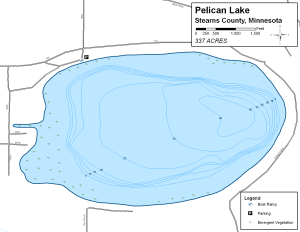
Are there boat launches on Pelican Lake?
Are there places to eat and drink near Pelican Lake?
Explore the Pelican Lake area in a RV
Are you looking for an adventurous vacation option that won't break the bank? Look no further than renting an RV! Contrary to popular belief, the process is much simpler than you might imagine. With just a few easy steps, you'll soon be experiencing the ultimate freedom and convenience of exploring the open road in your very own recreational vehicle. And the best part? RV travel can save you up to 60% compared to other types of vacations! With the money you'll save, you'll be able to travel even more and create unforgettable memories along the way. So why wait? Start planning your next adventure today with an RV rental. Learn more about renting a RV.



History & Status of the Fishery
Pelican Lake is a 337-acre lake located five miles northeast of Avon in Stearns County. It has a maximum depth of 46 feet and a small watershed dominated by agriculture (pasture/row crops) and open water. A state-owned public access is located on the northwest side of the lake. Pelican Lake is primarily managed for Walleye and Northern Pike and was last surveyed in 2016. Water clarity has always been good on the lake (10-year average - 13 feet) and was 17 feet on July 10th. Dissolved oxygen was adequate to support fish to 24 feet. Emergent and floating-leaf vegetation was last surveyed in 2016, and the primary species present were cattail and white waterlily.
Walleye numbers were similar to 2016 and remain within the range of expected values for lakes similar to Pelican Lake. Walleye fingerlings have been stocked by DNR for many years with supplemental stocking taking place by the lake association during years that DNR does not stock. Walleye lengths ranged from 18.4 to 24.5 inches with an average length and weight of 20.3 inches and 2.9 pounds. Growth is average in the lake with Walleye taking about six years to reach 20 inches. All Walleye sampled in 2023 were longer than 15 inches with 35% being longer than 20 inches, indicating that the size structure is skewed towards larger individuals and that recent stockings may not have been successful.
Northern Pike catches have been high in Pelican Lake for years. While the catch in 2023 was the lowest on record and pike numbers appear to have decreased in relation to historic numbers, they are still at the high end of what we would expect to see for lakes similar to Pelican Lake. Most pike were small, ranging in length from 14.6 to 34.7 inches with an average length and weight of 19.5 inches and 1.7 pounds. Only 21% of the Northern Pike sampled were longer than 21 inches and 9% were longer than 26 inches. Anglers should expect to catch ample numbers of small pike (< 22 inches) with an occasional larger (> 26 inches) fish.
Largemouth Bass were sampled on May 25th by daytime electrofishing. The catch rate of 42.2/hour was less than half the catch observed in 2016 and was lower than the Sauk Rapids Area daytime average of 52/hr. Lengths ranged from 6.5 to 18.0 inches with an average length of 12.0 inches. Fifty-three percent of Largemouth Bass were longer than 12 inches and 19% were longer than 15 inches. While the bass numbers appear to be down, the size structure is still in good shape and anglers have a good chance at catching a larger fish (> 15 inches).
The Bluegill catch was lower than 2016, but was similar to 2010 and within the expected range for lake class. Lengths ranged from 3.1 to 9.2 inches with an average length of 5.8 inches. While the Bluegill catch was low, anglers can expect to find a few nicer Bluegills roaming around the lake. Black Crappie numbers have always been low and catches in 2023 were no different. Lengths ranged from 7.0 to 13.6 inches with an average length of 10.4. While the crappie numbers are low, anglers may run into a few larger crappie (> 10 inches) during certain times of the year.
No Yellow Perch were captured in 2023 after only one was captured in 2016 and two were captured in 2010. Perch abundance is likely limited due to the high Northern Pike abundance and to a lesser degree, increasing Walleye numbers. Other species captured in 2023 included: Black, Brown, and Yellow Bullhead, Bowfin (Dogfish), Hybrid Sunfish, and Pumpkinseed.
What is the average air temp for Pelican Lake?
Are there any state parks near Pelican Lake?
For more Minnesota State Park information see our State Park Guide.
More Nearby Lakes To Explore
There's more lake's to explore around Pelican Lake...| DISTANCE | ACRES | MAX DEPTH | |
| Little Pine Lake | 0.7 mi | 17 | |
| Little Pelican Lake | 0.8 mi | 20 | |
| Pine Lake | 1.1 mi | 108 | 79 ft |
| Two Rivers Lake | 2.5 mi | 583 | 63 ft |
| Lower Spunk Lake | 2.8 mi | 179 | 28 ft |
| Schwinghammer Lake | 2.9 mi | 15 | |
| Ochotto Lake | 3.0 mi | 40 | 40 ft |
| Middle Spunk Lake | 3.4 mi | 236 | 81 ft |
| Lake Anna | 3.9 mi | 57 | |
| Unnamed Lake | 4.0 mi | 47 |


