


Big Lake
Stearns County, Minnesota


Share Your Catch & Win!
Frequently Asked Questions About Big Lake, MN
- How big is Big Lake?
- How deep is Big Lake?
- What kind of fish can you catch in Big Lake?
- What are the closest cities to Big Lake?
- Are there places to stay in the Big Lake area?
- Are there topographical lake maps available Big Lake?
- Are there boat launches on Big Lake?
- Are there places to eat and drink near Big Lake?
- What is the average air temp for Big Lake?
- Are there any state parks near Big Lake?
How big is Big Lake?
How deep is Big Lake?
What kind of fish can you catch in Big Lake?
Other fish species in the lake include Banded Killifish, Blackchin Shiner, Blacknose Shiner, Bluntnose Minnow, Brook Silverside, Brook Stickleback, Central Mudminnow, Common Shiner, Fathead Minnow, Green Sunfish, Hybrid Sunfish, Iowa Darter, Johnny Darter, Least Darter, Pugnose Shiner, Tadpole Madtom and White Sucker.
What are the closest cities to Big Lake?
Are there places to stay in the Big Lake area?
More Lodging Options
Are there topographical lake maps available Big Lake?
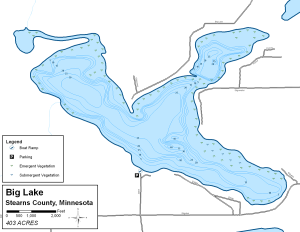
Are there boat launches on Big Lake?
Are there places to eat and drink near Big Lake?
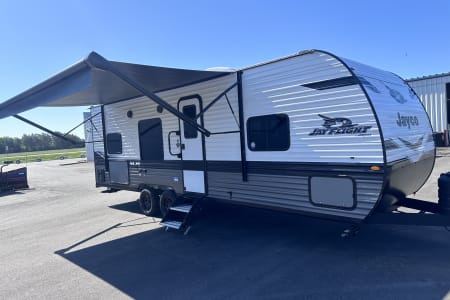
Explore the Big Lake area in a RV
Are you looking for an adventurous vacation option that won't break the bank? Look no further than renting an RV! Contrary to popular belief, the process is much simpler than you might imagine. With just a few easy steps, you'll soon be experiencing the ultimate freedom and convenience of exploring the open road in your very own recreational vehicle. And the best part? RV travel can save you up to 60% compared to other types of vacations! With the money you'll save, you'll be able to travel even more and create unforgettable memories along the way. So why wait? Start planning your next adventure today with an RV rental. Learn more about renting a RV.

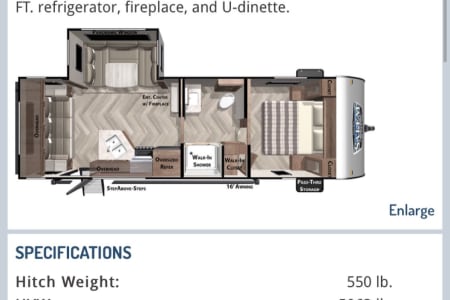
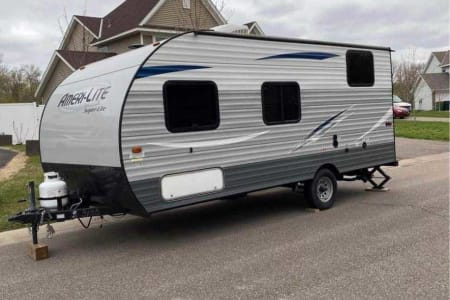
Extremely light, very easy to tow 2019 Gulf Stream Amerilite
Cold spring, MN
History & Status of the Fishery
Big Lake is a 458 acre lake located three miles southwest of the City of Richmond. It has a maximum depth of 42 feet with an average depth of 15 feet. Big Lake has good water quality and excellent water clarity with a 10 year average summer Secchi reading of 10 feet. The Big Lake watershed is 20,371 acres with land use consisting of 65% agriculture, 17% pasture, 6% marsh/open water, 5% forest, 4% residential, and 3% grassland. Walleye fingerlings are stocked every other year. There is one public access and two private accesses (Joe's Last Resort and Twilight Acres Resort) located on the lake. A standard survey was conducted in 2017 to monitor changes in the fishery from the last survey completed in 2012.
Big Lake has a diverse aquatic plant community. While no submerged plant survey was conducted in 2017, the last submerged plant survey conducted in 2012 found 13 species of aquatic plants growing to a depth of 9.5 feet. Muskgrass and sago pondweed were the most common. Emergent plants were mapped in 2017 and found to cover approximately 15% of the lake. Species found were bulrush spp. (2 acres), cattail spp. (36 acres), white waterlily (29 acres), and yellow water lily (2 acres).
Historically, Northern Pike have not been abundant in Big Lake, however, since 1994 their abundance has steadily increased. The catch in 2017 was higher than 2012 and above the range of expected values for lakes with similar characteristics, and the highest on record. Northern Pike ranged in length from 15 to 34 inches with an average length and weight of 20 inches and about two pounds. Ten percent of the Northern Pike were longer than 24 inches and 3% were longer than 30 inches.
Walleye fingerling stocking has been the stocking strategy for the past 50 years, although fry stocking was experimented with between 2003 and 2006. Due to poor survival, fry stocking was discontinued and management returned to biennial fingerling stocking in 2007. The catch in 2017 was the highest on record and above the range of expected values for the lake class. Walleye ranged in length from 10 to 25 inches with an average length and weight of 18 inches and two pounds. Seven year classes were present in the age sample with the 2014 year class making up 47% of the sample. Growth was fast with both males and females reaching 16 inches by age three.
Yellow Perch abundance remains low, similar to past surveys. Only 15 Yellow Perch were sampled during the survey and ranged from five to 8.5 inches in length.
Largemouth Bass were sampled during daytime electrofishing on May 11, 2017. A total of 302 Largemouth Bass were captured in 1.7 hours of effort for a catch rate of 179/hour. This was over four times higher than the average catch rate for daytime electrofishing in the Sauk Rapids area and almost twice the 2012 catch rate of 91/hr. Largemouth Bass ranged in length from 6 to 19 inches with an average length of ten inches.
The Bluegill catch in 2017 was higher than 2012 but still within the expected range. Big Lake does not have a history of producing large sunfish, but some larger Bluegills were sampled in 2017. Bluegill sampled ranged in length from three to nine inches; however only 25% of the catch were longer than six inches and 5% were longer than eight inches.
The catch of Black Crappie in 2017 was similar to past surveys and within the range of expected values for similar lakes; however, the gill net catch was above expected values for similar lakes. Seventy-six crappies were sampled during the survey and ranged in length from four to nearly 15 inches with an average length of eight inches. Of the catchable sized fish above five inches, 74% of the catch were longer than eight inches and 23% were longer than ten inches.
In 2017, Smallmouth Bass were sampled in Big Lake for the first time. Four Smallmouth Bass ranging from 16 to 18 inches in length were sampled during the summer gill net survey. Channel Catfish were first sampled in Big Lake in 2002, and do not appear to be increasing in abundance as only one catfish has been sampled in each of the two surveys since. It is likely that Smallmouth Bass and Channel Catfish immigrated from the Sauk River Chain of Lakes during high water as Big Lake is connected to Becker Lake via Kolling Creek.
Other species captured during the survey included: Black Bullhead, Bowfin (dogfish), Brown Bullhead, Green Sunfish, Hybrid Sunfish, and Pumpkinseed, White Sucker and Yellow Bullhead.
What is the average air temp for Big Lake?
Are there any state parks near Big Lake?
For more Minnesota State Park information see our State Park Guide.
Big Lake Reviews
Below is the word on street about Big Lake.Have you been to Big Lake? Why not share your personal reveiw with others?
Submit Review
nick j.

More Nearby Lakes To Explore
There's more lake's to explore around Big Lake...| DISTANCE | ACRES | MAX DEPTH | |
| Roschien Lake | 1.5 mi | 40 | |
| Deep Lake | 1.7 mi | 54 | 54 ft |
| Mud Lake | 1.9 mi | 67 | |
| Pirz Lake | 2.1 mi | 67 | |
| Horseshoe Lake | 2.2 mi | 629 | 57 ft |
| Becker Lake | 2.3 mi | 221 | 20 ft |
| Unnamed Lake | 2.8 mi | 10 | |
| Long Lake | 2.9 mi | 487 | 35 ft |
| North Brown's Lake | 3.3 mi | 312 | 41 ft |
| Cedar Island Lake | 3.8 mi | 986 | 75 ft |


