


Lake Alexander
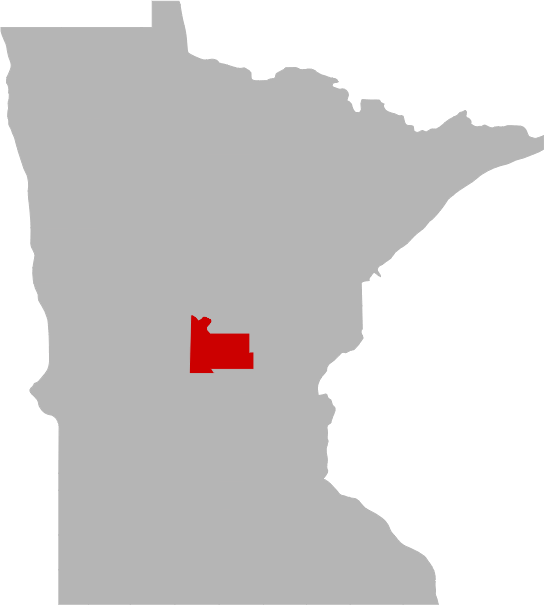
Morrison County, Minnesota
Share your catch!
We want to see what you've caught on Lake Alexander.Frequently Asked Questions About Lake Alexander, MN
- How big is Lake Alexander?
- How deep is Lake Alexander?
- What kind of fish can you catch in Lake Alexander?
- What are the closest cities to Lake Alexander?
- Are there places to stay in the Lake Alexander area?
- Are there topographical lake maps available Lake Alexander?
- Are there boat launches on Lake Alexander?
- Are there places to eat and drink near Lake Alexander?
- What are the fishing regulations for Lake Alexander?
- What is the average air temp for Lake Alexander?
- Are there any state parks near Lake Alexander?
How big is Lake Alexander?
How deep is Lake Alexander?
What kind of fish can you catch in Lake Alexander?
Other fish species in the lake include Banded Killifish, Blackchin Shiner, Blacknose Shiner, Bluntnose Minnow, Brassy Minnow, Brook Stickleback, Central Mudminnow, Cisco (Tullibee), Common Shiner, Fathead Minnow, Golden Shiner, Green Sunfish, Hornyhead Chub, Hybrid Sunfish, Iowa Darter, Johnny Darter, Least Darter, Mottled Sculpin, Northern Redbelly Dace, Shorthead Redhorse, Slimy Sculpin, Spotfin Shiner, Spottail Shiner, Tadpole Madtom and White Sucker.
What are the closest cities to Lake Alexander?
Are there places to stay in the Lake Alexander area?
More Lodging Options
Are there topographical lake maps available Lake Alexander?
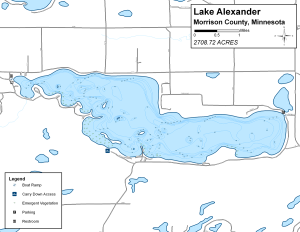
Are there boat launches on Lake Alexander?
Are there places to eat and drink near Lake Alexander?
What are the fishing regulations for Lake Alexander?
 There are specific fishing regulations Lake Alexander that you need to know. For complete fishing regulations visit the Minnesota Department of Natural Resources. To report a violation call (800) 652-9093. Need a Minnesota fishing license?
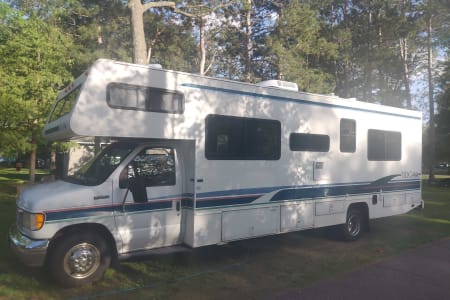
Explore the Lake Alexander area in a RV
Are you looking for an adventurous vacation option that won't break the bank? Look no further than renting an RV! Contrary to popular belief, the process is much simpler than you might imagine. With just a few easy steps, you'll soon be experiencing the ultimate freedom and convenience of exploring the open road in your very own recreational vehicle. And the best part? RV travel can save you up to 60% compared to other types of vacations! With the money you'll save, you'll be able to travel even more and create unforgettable memories along the way. So why wait? Start planning your next adventure today with an RV rental. Learn more about renting a RV.


What aquatic invasive species are found in Lake Alexander?
Join us in the fight to prevent the spread of invasive species These sneaky creatures can hitch a ride on boats, clinging onto propellers, anchor lines, and trailers. They can even survive in hidden places like bilge water and ballast tanks, or disguise themselves in dirt and sand that sticks to nets, buckets, anchors, and waders. But don't worry, we have the power to stop them in their tracks with just a few simple steps. So let's do our part and protect our waters from these unwanted invaders.
History & Status of the Fishery
Lake Alexander is a 2,708-acre lake located near Randall, Minnesota. The lake has 16.26 miles of shoreline, a maximum depth of 64 feet, and a littoral area of 842 acres. The primary management species is Walleye. Secondary management species include Largemouth Bass, Muskellunge, Northern Pike, and Smallmouth Bass. The Walleye population on Lake Alexander is managed through annual stocking of 2,500,000 fry. This stocking strategy has maintained a population that sustains a very good recreational fishery. Recent documentation of a significant natural year class (2020) when no stocking occurred due to COVID19 shutdowns may lead to future adjustments to stocking strategies to allow assessment of natural reproduction.
Night electrofishing in the fall has been used to evaluate young of the year Walleye abundance from spring fry stocking or natural reproduction since 1994. Fall electrofishing in 2023 was completed on September 19, to assess Walleye fry stocking survival. For the first time, electrofishing efforts failed to document the presence of young of the year Walleye following a fry stocking. Prior to 2023, the 2022 fall electrofishing catch rate (8.5/hour) of young of the year Walleye was the lowest rate observed on Lake Alexander in a fry stocked year. Catch rates in prior fall assessments ranged from 21.4/hour (1997) to 733.1/hour (2007) with a median catch rate of 114.0/hour. Catch rates in the last four fall assessments have been at or below the 1st quartile (34.0/hour) established from previous assessments on the lake. The fall 2020 catch of young of the year Walleye (24.5/hour) was the highest catch rate observed for naturally produced fish. These results indicate further analysis of natural reproduction should be continued by adjusting stocking schedules and continuing fall electrofishing assessments in both stocked and non-stocked years.
Historically, fall electrofishing catch rates of juvenile Walleye have been a good predictor of future year class strength in summer gill net surveys. Analysis of fall electrofishing catches showed that, in general, high fall catch rates have typically corresponded with higher catches in future gill net surveys. Low fall catch rates, however, do not always signify poor year classes as represented by future gill net catches. Fall catch rates as low as 21.0/hour have been well represented in future gill net surveys above the third quartile (2.3/net). Other years with low fall electrofishing catch rates produced significant year classes of more than 1.5/gill net. Due to low catch rates in the last four fall young of the year assessments a decision was made to stock 10,943 Walleye fingerlings (981 pounds). Mixing fry and fingerling stocking in 2023 will confound analysis of future gill net catches of this year class although it will probably be assumed, right or wrong, that fish came from fingerling stocking.
Nine Walleyes were sampled during the survey ranging from 9.7 to 17.8 inches in total length. Seven yearlings were sampled and averaged 10.4 inches in total length. Catch rate of yearling Walleye was 5.6/hour. Juvenile and adult Yellow Perch were present in good numbers as were Shiner species. Various sunfish species were abundant at some sites and some Bluegill approaching 8 inches were observed. Largemouth, Smallmouth, and Rock Bass were also common. A few Northern Pike and adult White Suckers were observed. The electrofishing crew observed that electrofishing stations appeared to contain good habitat conditions for juvenile Walleye.
What is the average air temp for Lake Alexander?
Are there any state parks near Lake Alexander?
For more Minnesota State Park information see our State Park Guide.
More Nearby Lakes To Explore
There's more lake's to explore around Lake Alexander...| DISTANCE | ACRES | MAX DEPTH | |
| Bernhart Lake | 1.3 mi | 10 | |
| Mud Lake | 2.1 mi | 62 | |
| Lagerquist Lake | 2.6 mi | 31 | 49 ft |
| Ham Lake | 2.8 mi | 42 | 22 ft |
| Round Lake | 2.9 mi | 99 | 18 ft |
| Round Lake | 2.9 mi | 99 | 18 ft |
| Round Lake (Bergstrom) | 2.9 mi | 99 | 18 ft |
| Pugh Lake | 3.0 mi | 20 | |
| Johnson Lake | 3.1 mi | 22 | |
| Fish Trap Lake | 3.5 mi | 1,164 | 42 ft |


