


Lake Ida
Douglas County, Minnesota

Share your catch!
We want to see what you've caught on Lake Ida.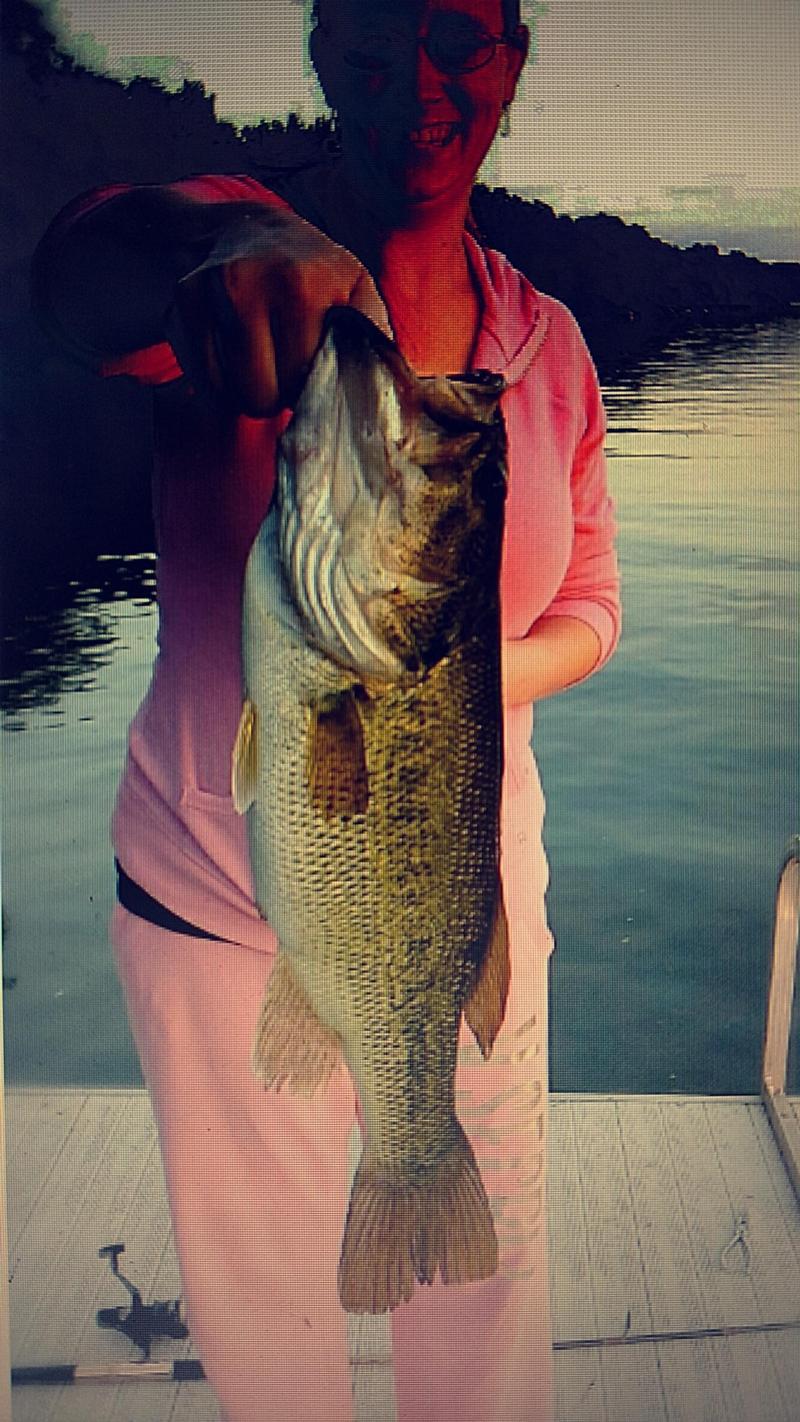
Frequently Asked Questions About Lake Ida, MN
- How big is Lake Ida?
- How deep is Lake Ida?
- What kind of fish can you catch in Lake Ida?
- What are the closest cities to Lake Ida?
- Are there places to stay in the Lake Ida area?
- Are there bait or tackle shops near Lake Ida?
- Are there topographical lake maps available Lake Ida?
- Are there boat launches on Lake Ida?
- Are there places to eat and drink near Lake Ida?
- What is the average air temp for Lake Ida?
- Are there any state parks near Lake Ida?
How big is Lake Ida?
How deep is Lake Ida?
What kind of fish can you catch in Lake Ida?
Other fish species in the lake include Banded Killifish, Bluntnose Minnow, Cisco (Tullibee), Common Shiner, Fathead Minnow, Golden Shiner, Green Sunfish, Hybrid Sunfish, Johnny Darter, Logperch, Mimic Shiner and White Sucker.
What are the closest cities to Lake Ida?
Are there places to stay in the Lake Ida area?
More Lodging Options
Are there bait or tackle shops near Lake Ida?

Are there topographical lake maps available Lake Ida?
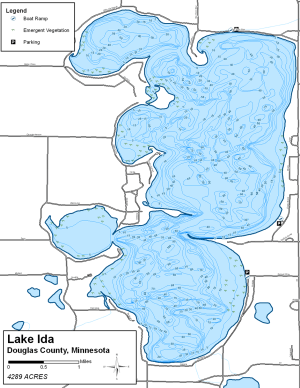
Are there boat launches on Lake Ida?
Lake Ida area businesses:
Are there places to eat and drink near Lake Ida?
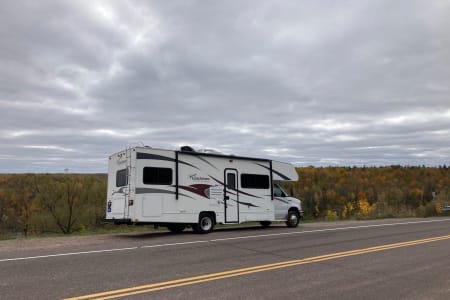
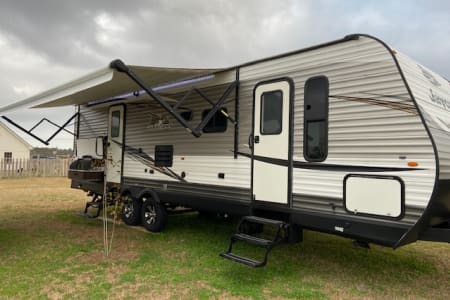
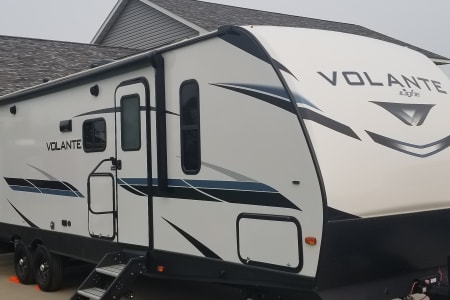
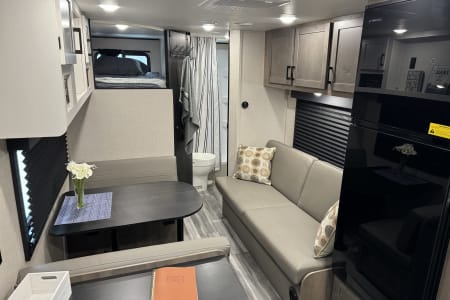
Explore the Lake Ida area in a RV
Are you looking for an adventurous vacation option that won't break the bank? Look no further than renting an RV! Contrary to popular belief, the process is much simpler than you might imagine. With just a few easy steps, you'll soon be experiencing the ultimate freedom and convenience of exploring the open road in your very own recreational vehicle. And the best part? RV travel can save you up to 60% compared to other types of vacations! With the money you'll save, you'll be able to travel even more and create unforgettable memories along the way. So why wait? Start planning your next adventure today with an RV rental. Learn more about renting a RV.
What aquatic invasive species are found in Lake Ida?
Join us in the fight to prevent the spread of invasive species These sneaky creatures can hitch a ride on boats, clinging onto propellers, anchor lines, and trailers. They can even survive in hidden places like bilge water and ballast tanks, or disguise themselves in dirt and sand that sticks to nets, buckets, anchors, and waders. But don't worry, we have the power to stop them in their tracks with just a few simple steps. So let's do our part and protect our waters from these unwanted invaders.
History & Status of the Fishery
Lake Ida is a 4,432-acre, moderately fertile basin located northwest of Alexandria. Maximum depth exceeds 100 feet. Mean depth is approximately 28 feet. Lake Ida lies within the Long Prairie River watershed and is connected to Lake Miltona to the north and Lake Charley to the south via non-navigable channels. Water quality and clarity are considered good. Water clarity has increased since establishment of zebra mussels and often exceeds 15 feet during summer months. Residential development surrounds much of the lake. Lake Ida supports a complex fish community due to good water quality and exceptional habitat diversity such as shallow bays, rock bars, abundant mid-lake structure, and vast areas of emergent and submergent vegetation. This lake is a popular destination for both anglers and recreational boaters. Recreational pressure can be heavy, especially on weekend days during summer months. Three access sites are available for public use. Two on the east shore and one on the north. The north access has limited parking and is relatively shallow. Launching of large boats at this site can be challenging, especially during low water periods. Boaters should also be cautious of shallow rock bars off the following points: Pilgrim and Stony (the two points that separate the north and south portions of the lake) and Betsy Ross (the point entering the northwest bay). These areas are typically posted with caution signs. Primary fish management efforts are focused on Walleye with bass and sunfish being species of secondary management importance.
A standard fisheries survey was completed in 2023 to assess the fish community and gain updated estimates of abundance and size structure of gamefish populations. Lake Ida is well known as a quality Walleye fishery. Walleye abundance (7.3 fish/gill net) has increased since the record-low level that was documented in 2019. Higher abundance can be attributed to increased survival and recruitment of young fish in recent years. Approximately 84% of the gill net sample was comprised of Walleye age 4 or younger. The dominant 2019 year class accounted for almost 60% of gill net captures. Mean size of Walleye captured in 2023 was 17.2 inches and 1.9 pounds. Lake Ida supports both Largemouth and Smallmouth Bass populations. Largemouth Bass are more abundant but average size of Smallmouth Bass tends to be larger. Maximum lengths of bass sampled in 2023 were 17.7 inches for Largemouth and 18.5 inches for Smallmouth. Panfish populations, particularly Bluegill and Black Crappie, are abundant. Current size structure for Bluegill is considered fair to good. Mean length of Bluegill captured in 2023 was 5.3 inches for trap nets and 6.6 inches for gill nets. Angler catches of larger sunfish are common. Current size structure of crappie is considered good. Mean and maximum lengths of Black Crappie captured in 2023 were 10.1 and 12.2 inches. Rock Bass sustain an abundant population and contribute to fishing, but relatively few are harvested. Yellow Perch abundance is low and harvestable-size perch are rare. Northern Pike are not abundant (4.5 fish/gill net) but size structure of this population has improved in recent years. Average size in 2023 was 24.2 inches and 3.3 pounds. The largest pike measured was just over 36 inches. Northern Pike zone regulations were implemented in 2018 to help improve pike size structure. Lake Ida is located in the North-Central Zone. Anglers can keep up to 10 pike but not more than two can be over 26 inches in length. All pike between 22-26 inches must be immediately released. One Muskellunge, a 45-inch individual, was captured during the 2023 survey. This trophy gamefish is not stocked into Lake Ida, thus abundance is low. Presence of this species in Lake Ida is from downstream emigration from Lake Miltona. Lake Ida also supports opportunities to catch and harvest Tullibee, also referred to as Cisco or Lake Herring, and is one of only two lakes in the Glenwood Management Area where sport gill netting for this species is allowed.
Other species captured during the 2023 survey included Brown and Yellow Bullhead, Bowfin (Dogfish), Common Carp, Green Sunfish, hybrid sunfish, and Pumpkinseed. The next lake survey is tentatively scheduled for 2027.
Lake Ida is designated as an infested waterbody due to presence of zebra mussels, which were first confirmed in 2013. For more information regarding aquatic invasive species in Minnesota see the following: http://www.dnr.state.mn.us/invasives/aquatic/index.html.
What is the average air temp for Lake Ida?
Are there any state parks near Lake Ida?
For more Minnesota State Park information see our State Park Guide.
More Nearby Lakes To Explore
There's more lake's to explore around Lake Ida...| DISTANCE | ACRES | MAX DEPTH | |
| Unnamed Lake | 1.6 mi | 27 | |
| Lake Charley | 3.2 mi | 131 | |
| Unnamed Lake | 3.2 mi | 35 | |
| Hidden Lake | 3.5 mi | 14 | 18 ft |
| Lake Carlos | 3.5 mi | 2,605 | 163 ft |
| Indian Lake | 3.7 mi | 99 | 38 ft |
| Buckskin Lake | 3.7 mi | 47 | |
| Lake Louise | 4.1 mi | 214 | 33 ft |
| Mork Pond | 4.1 mi | 27 | |
| Laura Lake | 4.1 mi | 59 |


