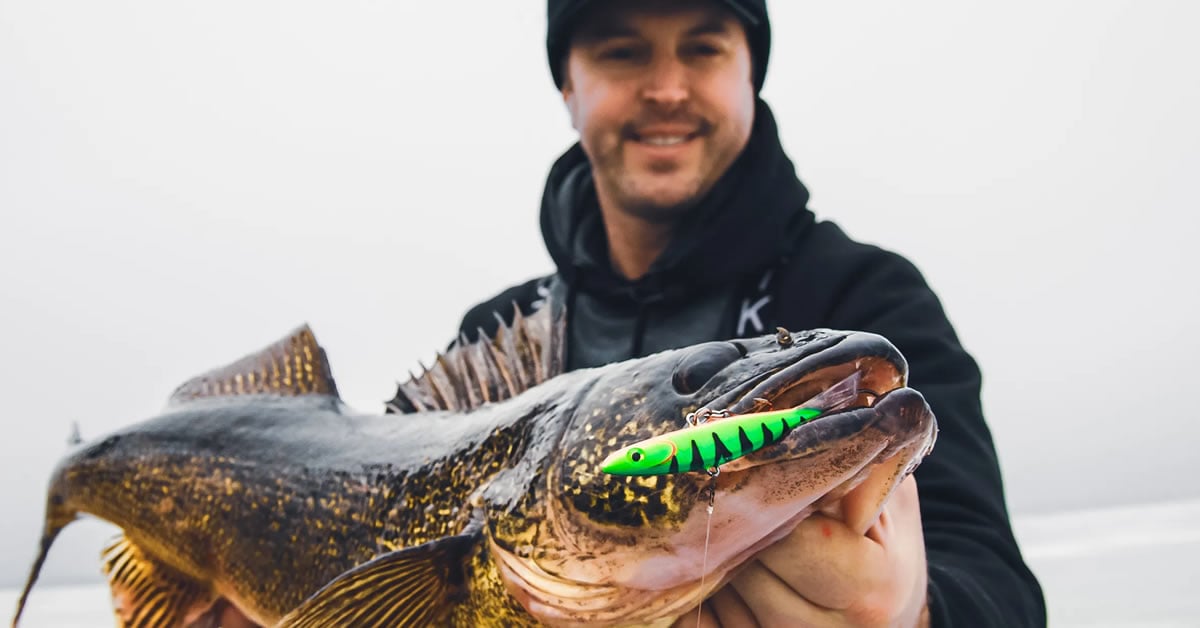
Early Season Walleyes
by Bob Jensen
 As the waters warm, walleyes change the way they do things. Earlier in the year, they were in the shallows spawning. Now that the spawn is complete, the walleyes will maybe stay in the shallows, or they might move into deeper water. Where they are depends on where their food is. In the spring walleyes will be in shallow water spawning. The rest of the year, they will be wherever their food is. If you want to catch walleyes, or any specie of fish, you need to put your bait where the fish are.
Many anglers like to cover water in their search for walleyes. Walleyes might be on flats or reefs, or they might be suspended. A great way to cover water is by trolling spinner rigs. Here’s how to do it.
First we need to select a spinner rig. You won’t go wrong with either a Baitfish-Image Spinner Harness or a Baitfish Float’n Spin. These rigs both have holographic blades. Holographic blades have proven themselves to be great fish attractors. Start with a Gold Shiner or Firetiger blade in stained water and a Silver Shiner or Yellow Perch in clear water. Don’t get locked into one color though: Keep experimenting until the fish show what they want.
For weight, use either a bottom bouncer or, better yet, a Rock Runner Slip Bouncer. The slip bouncers allow an angler to change weight without cutting and retying the line.
 Use enough weight to keep the weight on the bottom at about a forty five degree angle behind the boat, maybe a little farther behind the boat in clear water. If the water being fished is clear or shallow, it would be a good idea to get the spinners away from the boat by employing Off Shore planer boards. Off Shores are the best running boards available.
The spinners we’re using are made for use with crawlers. There is a very noticeable trend to using either Power Crawlers or Gulp! crawlers on the spinners. Panfish, bullheads, and sheepshead will rip a live crawler to shreds very quickly, making them unproductive. They will still nip at the soft baits, but the soft baits will be much more durable.
When you have identified an area that you think should hold fish, begin trolling. In shallow or flat water, I prefer to use my bow mount Minn Kota electric motor to troll. Speed can be set exactly where you want it with this motor. Somewhere around one mile per hour is a good starting point. I have a Humminbird sonar unit right next to the electric motor, and it reads speed to a tenth of a mile. Sometimes .9 is the best speed, sometimes 1.2 will be more productive. Watching the speed on the sonar can produce big results.
Vary speed, blade color, and don’t work too slowly through an area. Keep moving until you find the fish, then refine your presentation until you know exactly what they want and how they want it. When you do that, you’re going to discover just how effective spinners are for walleyes during the summer months.

Bob Jensen's 45 year career in the fishing and outdoor industry includes producing and hosting award-winning television and radio shows, co-authoring 5 best-selling books, writing a weekly syndicated outdoor column and numerous feature articles, and presenting fishing seminars at various outdoor events.